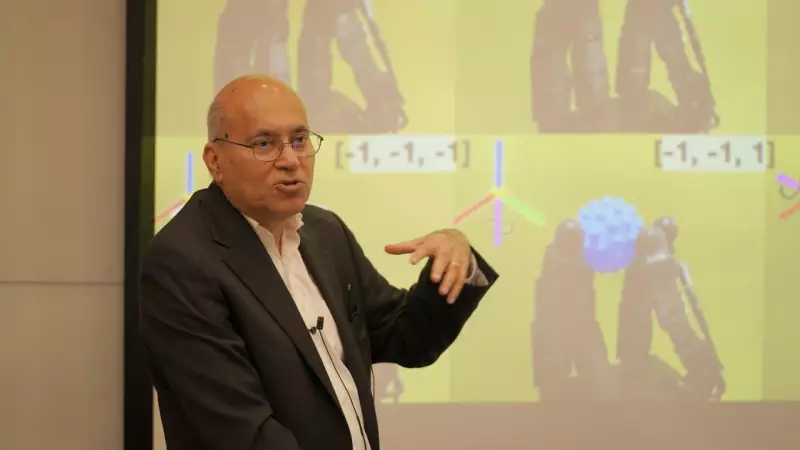
Meta Platforms Inc. has suffered another major blow to its artificial intelligence research ambitions, with a top executive announcing his departure to join a key rival. Jitendra Malik, a Vice President and distinguished scientist, has left Meta's Fundamental AI Research (FAIR) unit to lead Amazon's robotics research efforts in San Francisco. This move adds to a growing exodus of senior talent from what was once considered the social media giant's crown jewel in AI development.
A High-Profile Exit and a Lab in Crisis
Jitendra Malik, who also held a professorship at UC Berkeley, publicly announced his career shift on the social media platform X on January 4. He stated he would begin his new role at Amazon on January 5, marking a swift transition. In his post, Malik reflected on his team's significant contributions at Meta, which included pioneering work on video action recognition models, advanced tactile sensors, and the recent SAM 3D breakthrough in computer vision.
His resignation follows closely on the heels of the departure of chief AI scientist Yann LeCun and forms part of a worrying pattern for Meta. The company has seen a steady stream of top researchers, who were instrumental in building its reputation as an AI powerhouse, leave the organization. The situation at FAIR has become so dire that some former employees have described the once-prestigious lab as "dying a slow death."

FAIR's Identity Shift: From Open Research to Product Focus
The turmoil at FAIR has been brewing for over a year, intensifying after CEO Mark Zuckerberg declared a "year of intensity" in January 2025. Since then, the research division has undergone multiple reorganizations, faced budget pressures, and witnessed a dramatic talent drain. Notably, more than half of the authors of the original Llama research paper left Meta within months of its publication.
According to former FAIR researchers who spoke to Fortune, Meta has systematically deprioritized open-ended, blue-sky research in favor of initiatives driven by product development under its GenAI organization. Former staff also reported that FAIR now receives less computing power compared to teams focused on generative AI, though Meta has declined to confirm these internal resource allocations.
The instability peaked in August 2025 when Meta consolidated its AI ambitions by splitting its Superintelligence Labs into four teams. This reshuffle created confusion over project ownership and team responsibilities. The reorganization was followed by 600 job cuts in October, which Chief AI Officer Alexandr Wang stated were necessary to speed up decision-making processes.
Internal Tensions and a Questionable Future
The internal conflict came to a head with Yann LeCun's exit. He left to pursue his own project on "world models," a path that diverges from the large language model (LLM) strategy that now defines Meta's AI approach. In a candid December interview with the Financial Times, LeCun admitted that Meta's results for the Llama 4 model were "fudged a little bit" and criticized the company's singular focus on LLMs as incompatible with the goal of achieving superintelligence.
Other former employees have echoed these sentiments. Ex-research scientist Tian Yuandong, who left in November, told Chinese media that internal conflicts erupted as computing resources became scarce amid the industry-wide race to develop LLMs. Another former employee, Joena Zhang, noted that during the first half of 2025, "nobody really knew what anyone was doing" within the newly formed Meta Superintelligence Labs.
Despite the challenges, Meta maintains it is still committed to FAIR. The company points to internal employee sentiment surveys which showed optimism had risen to 80% by late 2025, suggesting some improvement in morale following the turbulent restructuring period.