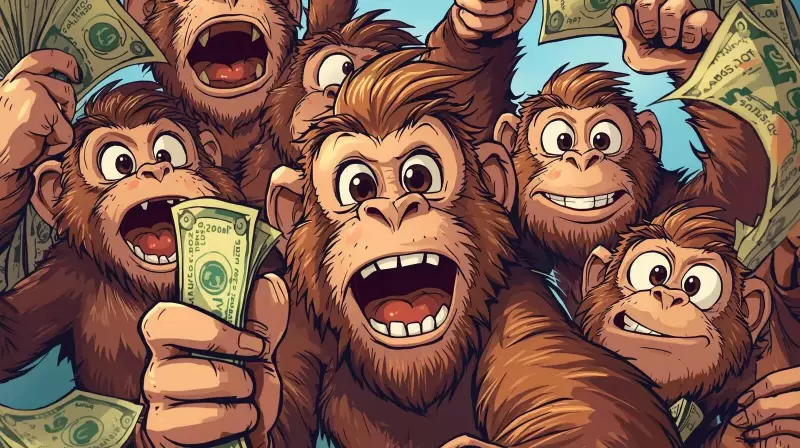
Monkeys Mirror Human Money Mistakes in Groundbreaking Yale Research
Scientific investigations into decision-making processes typically begin with human subjects. Sometimes, however, researchers turn their attention elsewhere. A fascinating study from Yale University has now identified familiar patterns appearing in an unexpected place: the behavior of monkeys.
The Core Concept: Loss Aversion
Loss aversion represents a fundamental psychological pattern where avoiding losses feels significantly more important than achieving equivalent gains. This concept influences countless decisions, from minor daily choices to major financial investments.
In carefully controlled experiments, Yale researchers observed capuchin monkeys trading tokens for food while prices and outcomes systematically changed. The monkeys' responses demonstrated clear patterns rather than random behavior. Their actions frequently aligned with behaviors extensively documented in human economic studies.

These findings suggest certain economic habits might originate deeper than cultural influences or formal education. They could emerge from ancient mental patterns shared across primate species, shaped long before modern concepts of money developed.
How the Study Worked
Scientists did not attempt to teach monkeys complex economics. Instead, they simply observed what happened when choices involved inherent risk. Researchers selected capuchin monkeys for their alertness, social nature, and quick learning abilities.
The monkeys received tokens they could exchange for desirable foods like fruit pieces or gelatine cubes. The setup remained deliberately simple, focusing on basic exchange without language or complicated instructions beyond repetition.
Monkeys Respond to Changing Prices
In one series of trials, monkeys received a limited token supply while food prices changed between sessions. Sometimes apples required more tokens, sometimes fewer. The available spending amount also varied.
The monkeys' behavior adapted to these changes predictably. When prices increased, spending decreased. When budgets expanded, spending rose. These responses followed patterns economists would immediately recognize. Little evidence suggested guessing or confusion. The monkeys appeared to notice cost changes and respond accordingly, even as conditions shifted.
Uncertain Rewards Trigger Strong Reactions
Another experiment focused less on pricing and more on risk perception. Monkeys chose between two options. The first offered one visible food piece with a chance of receiving an extra piece. The second showed two food pieces but sometimes had one taken away.
Mathematically, both options were equal, each providing identical probabilities of ending with one or two pieces. The monkeys did not perceive them as equal. They strongly preferred the option that felt like a potential gain over the option that risked losing something already visible. This pattern closely mirrors how humans typically respond in similar situations.
What This Reveals About Economic Behavior
Researchers found this combination particularly noteworthy. Monkeys acted rationally when prices changed but showed clear bias when loss entered the equation. Rational choice and systematic error appeared side by side.
This combination occurs commonly in human behavior. People often manage everyday trade-offs effectively yet struggle significantly with risk and uncertainty. The study suggests this mixture might not simply result from modern life complexities. It could reflect older decision-making processes that humans still carry within them.
Why These Findings Remain Important
The research provides valuable context for understanding how people approach saving and investing. Many individuals avoid risk even when long-term returns would favor taking it. Loss aversion offers one explanation. Observing identical responses in monkeys suggests this tendency might be particularly difficult to override.
The study does not claim these behaviors are wrong or offer specific advice. It simply demonstrates that the instinct to avoid loss appears to run deeper than market experience or financial training. Where this leaves modern decision-making remains less clear, as the research appropriately stops short of drawing firm conclusions.

This information originates from Yale University research publications. The study contributes to our growing understanding of how ancient cognitive patterns continue to shape contemporary economic decisions across species.