Dutch Company Revolutionizes Funeral Industry with Mushroom-Based Products
Loop Biotech, a Netherlands-based company, is transforming how we think about death and burial. Founders Bob Hendrikx and Lonneke Hendrikx developed an innovative approach using mycelium, the underground root network of mushrooms, to create sustainable funeral products. Their work offers a genuine alternative to traditional methods that harm the environment.
Student Project Grows into Environmental Solution
The concept emerged when the designers studied at Delft University of Technology. They questioned the environmental impact of conventional funerals. Wooden coffins require cutting down trees, while cremation releases carbon dioxide and other polluting gases into the atmosphere. Loop Biotech presents their products as solutions that leave a lighter footprint on Earth.
Their mushroom-based items undergo a careful design process to decompose naturally in soil. The company maintains that death should not damage the planet. Instead, human bodies can nourish the earth again without creating long-lasting pollution.

How Mushroom Coffins Work
Loop Biotech focuses on collaboration with living systems rather than industrial materials. They grow products using mycelium combined with upcycled hemp fibers. Mycelium serves as a natural binding structure, eliminating the need for glues, metals, and chemical treatments typically used in coffin production.
At their growing facility in Delft, materials transform into finished forms within approximately seven days. This process demands minimal energy and produces no toxic waste. The material only begins decomposing when it contacts soil and moisture, allowing safe storage before use.
Mycelium as Nature's Recycler
Mycelium has attracted significant attention in recent years for its ability to break down organic matter and release nutrients back into soil. Underground, it plays a crucial role in nutrient cycles by connecting plants and decomposing dead material.
Loop Biotech leverages this property to create funeral products that actively enrich soil rather than sealing it off. According to the company, their material fully decomposes in about 45 days. This decomposition supports microbial life and improves soil quality around burial sites.
The Loop Living Cocoon
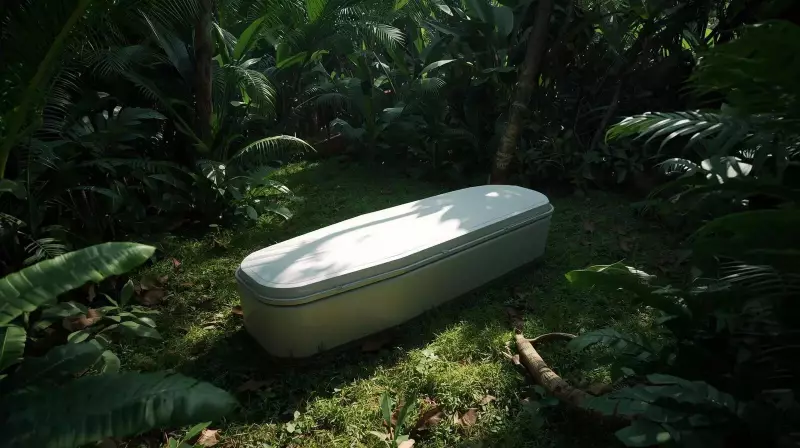
The company's most famous product is the Loop Living Cocoon, described as the world's first mushroom-based coffin. It fits standard burial plots and funeral equipment perfectly. Six jute handles allow it to be carried like conventional coffins.
The cocoon undergoes testing for strength, stability, and water resistance. It can carry up to 200 kilograms and comes in one size suitable for most adults. Funeral homes do not need to alter their procedures to accommodate this innovative product.
Additional Burial Options
Beyond coffins, Loop Biotech produces other burial alternatives. The Loop EarthRise urn uses the same mycelium and hemp mixture. When placed in soil, it can help grow a tree or plant. The Loop ForestBed serves as a simpler burial product designed to rest directly in the ground, ensuring close contact with soil organisms.
All products follow the same principle of complete biodegradability and nutrient return to the earth.
Pricing in US Dollars
Loop Biotech displays prices in euros. Using an approximate exchange rate of 1 euro to 1.08 US dollars:
- The Loop Living Cocoon costs between €1,495 and €1,806, converting to about $1,615 to $1,950.
- The Loop ForestBed ranges from €995 to €1,306, converting to around $1,075 to $1,410.
- The Loop EarthRise urn prices between €95 and €195, converting to roughly $103 to $211.
Prices may vary depending on region and funeral provider. Local taxes and additional services might increase the total cost.
Integrating with Existing Funeral Practices
Loop Biotech has gained attention by avoiding disruption to current systems. Their products work within existing burial frameworks rather than replacing them entirely. Cemeteries do not require special plots, and cremation remains available for those who prefer it.
The company presents their work as an option rather than a statement. They target people seeking lower-impact choices without changing familiar rituals.

Environmental Questions Around Death Continue
Funeral practices rarely feature in environmental debates, yet their impact persists continuously. Loop Biotech's work contributes to broader conversations about how daily systems, including those surrounding death, affect land use and emissions.
The company does not claim to solve these issues alone. Instead, they offer a small shift in direction. Their products suggest that even at life's end, materials can return quietly to the ground without leaving concrete, metal, or smoke behind.