Elon Musk's Ambitious Plan for Space-Based AI Data Centers
Elon Musk, the visionary entrepreneur behind SpaceX and xAI, is pushing forward with a groundbreaking initiative to deploy AI data centers in space. This move comes as part of a broader strategy to gain an edge in the highly competitive artificial intelligence race against tech giants such as Alphabet's Google, Meta, and OpenAI. According to a Reuters report from January 30, 2026, a proposed merger between SpaceX and xAI could accelerate these efforts, potentially revolutionizing how AI computing is handled globally.
What Are Space-Based AI Data Centers?
Space-based data centers represent an innovative, albeit early-stage, concept that involves networks of hundreds of solar-powered satellites orbiting Earth. These satellites are designed to meet the enormous computational demands of advanced AI systems, including xAI's Grok and OpenAI's ChatGPT. With Earth-based facilities becoming increasingly expensive to operate due to high energy consumption, advocates argue that orbital data centers offer significant advantages.
- Constant Solar Power: Operating above the atmosphere provides nearly uninterrupted access to solar energy, reducing reliance on traditional power sources.
- Efficient Cooling: By radiating heat directly into space, these centers eliminate the costly cooling burdens associated with ground-based facilities.
- Potential Cost Savings: Musk has stated that space could become the lowest-cost location for AI processing within two to three years.
However, experts caution that commercial viability is still years away, citing challenges such as space debris, cosmic radiation, limited maintenance options, and high launch costs. Deutsche Bank projects initial small-scale deployments by 2027–28, with larger constellations potentially emerging in the 2030s if early tests prove successful.

Why Is Musk Pursuing This Strategy?
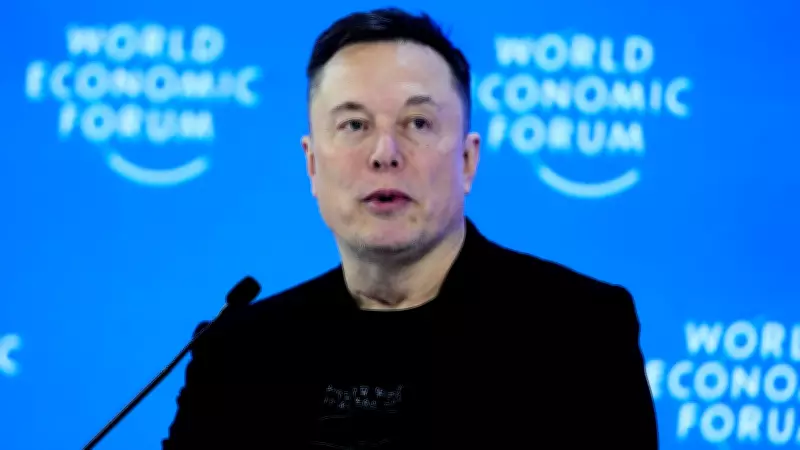
SpaceX, with its proven track record as a leading rocket-maker and operator of the Starlink satellite internet service, is uniquely positioned to spearhead this initiative. Musk emphasized the logic behind this approach at the World Economic Forum in Davos, calling it a "no-brainer" to build solar-powered data centers in space for cost efficiency. Additionally, SpaceX is considering an initial public offering that could value the company at over $1 trillion, with part of the proceeds earmarked for funding AI data center satellite development.
Competition in the Orbital AI Computing Space
Musk is not alone in exploring space-based AI computing. Several key players are also investing in this futuristic technology:
- Blue Origin: Founded by Jeff Bezos, this company is developing technology for orbital data centers, predicting that "giant gigawatt data centers" in space could outperform Earth-based counterparts in cost within 10 to 20 years.
- Starcloud: Backed by Nvidia, this venture has launched the Starcloud-1 satellite, equipped with an Nvidia H100 chip, to train and run AI models like Google's Gemma. It aims to create a modular "hypercluster" of satellites offering computing power comparable to multiple hyperscale data centers.
- Google: Through Project Suncatcher, Google is researching networked solar-powered satellites with Tensor Processing Units, planning a prototype launch with Planet Labs around 2027.
- China: State media reports indicate plans to develop a "Space Cloud" with gigawatt-class AI data centers over the next five years, led by China Aerospace Science and Technology Corporation.
As the AI race intensifies, space-based computing could redefine the landscape, offering sustainable and cost-effective solutions for the future of technology.