

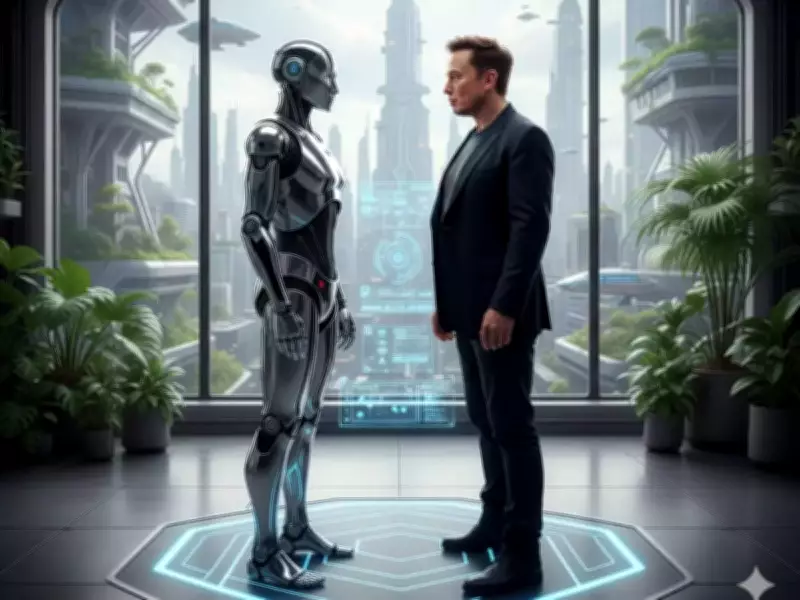
Elon Musk's Grand Vision for Tesla's Optimus Humanoid Robot
Elon Musk has presented an expansive and forward-looking vision for Tesla's Optimus humanoid robot, framing it not merely as a factory or household assistant but as a transformative technology with profound implications for humanity's future. The Optimus robot is described as a general-purpose, bipedal, humanoid machine designed to perform tasks that are unsafe, repetitive, or mundane, potentially revolutionizing labor on Earth.
Optimus as a Self-Replicating Machine for Planetary Expansion
In a bold statement on social media platform X, Musk explicitly connected Optimus to the concept of a Von Neumann machine, a theoretical system proposed in the mid-twentieth century that can reproduce itself using local resources. He wrote, "Yes. Optimus will be the first Von Neumann machine, capable of building civilization by itself on any viable planet." This suggests a future where robots could arrive ahead of humans on other worlds, extract materials, construct infrastructure, repair themselves, and gradually expand their numbers without direct human oversight.
Autonomous Civilisation Building in Space
Such capabilities would make Optimus critical for building and sustaining settlements on the Moon, Mars, or other celestial bodies. By operating independently in harsh environments, these humanoid robots could prepare habitats, power systems, and manufacturing facilities before human arrival. This approach aims to reduce risk to human crews and enable expansion at scales that would otherwise be impractical, with an emphasis on long-term autonomy rather than near-term deployment.

Musk's Claims on Optimus's Significance
Musk has repeatedly described Optimus as the most significant product ever built by humanity, arguing that large-scale deployment on Earth could make most forms of work optional. He has suggested this could help eliminate poverty before humanity turns its focus outward to space exploration. These claims place the robot within broader debates about labor, economic systems, and automation, positioning it as more than just consumer technology.
Current Development Status and Challenges
Despite the grand scale of this vision, Optimus remains in early development stages. Tesla continues to work on key aspects such as:
- Balance and mobility for bipedal movement
- Dexterity for handling complex tasks
- Perception systems for environmental awareness
- Autonomous decision-making capabilities
While mass production is a stated goal, self-replication and off-world civilization building are distant milestones. For now, Optimus serves as a signal of intent, outlining how Musk envisions robotics shaping both Earth's economy and humanity's future beyond our planet.
The integration of Optimus into space exploration plans highlights its potential role in autonomous operations beyond Earth, where it could be equipped for long-term independence. This positions the robot at the intersection of artificial intelligence, robotics, and space exploration, though Musk acknowledges that much of this vision remains years away from practical reality.

