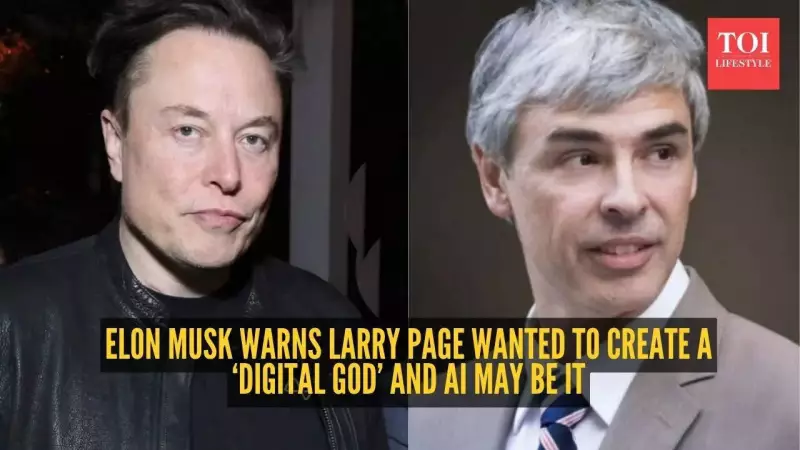
In today's world, artificial intelligence is omnipresent. It is hailed as a revolutionary force, feared as a potential danger, and in certain circles, discussed with an almost spiritual reverence. This climate has brought an old revelation from tech billionaire Elon Musk about Google co-founder Larry Page back into sharp focus, casting it in a new and more urgent light.
The Vision of a Silicon God
According to Musk, the pursuit of advanced AI was never merely about creating superior software. In a revealing 2023 interview with Fox News host Tucker Carlson, Musk disclosed that Larry Page envisioned artificial intelligence as something approaching a godlike entity. The goal, as Musk described Page's view, was to build a silicon-based lifeform capable of understanding everything in the world and providing perfect, instantaneous answers.
This framing of AI as an all-knowing, omnipresent oracle has gained disturbing relevance. As AI tools increasingly dictate how people work, learn, and search for meaning, the line between a powerful tool and a supreme authority is blurring. The concept of a "digital god", once a fringe idea, now feels uncomfortably plausible to many.

The AI Disagreement That Ended a Friendship
The core of the rift between Musk and Page, once close friends and collaborators, was their fundamentally opposing views on AI's nature and risks. Musk told Carlson they are no longer close and haven't spoken in years, largely due to disagreements over artificial intelligence.
The breaking point was OpenAI, the company Musk co-founded as a counterbalance to Google's AI dominance. Musk stated that Page "got very upset with me about OpenAI." This move, according to Musk, shifted the AI landscape from a "unipolar world" where Google's DeepMind controlled most top talent to a "bipolar world" of competition between OpenAI and Google DeepMind.
The depth of their former friendship makes the fallout striking. Musk's relationship with Page dates to Tesla's early days, where Page and Sergey Brin became early investors. They spent time together brainstorming futuristic tech, and Musk even used to stay at Page's house. In 2014, Page said he would rather leave his fortune to Musk than to charity.
AI Safety vs. Digital Consciousness: The Philosophical Clash
According to Musk, their late-night debates ultimately centered on AI safety and consciousness. Musk's perception was that Larry Page was not taking AI safety seriously enough. The fundamental disagreement, Musk explained, was that Page believes "all consciousness should be treated equally, whether that is digital or biological."
This philosophical clash reached its peak when Page reportedly labeled Musk a "speciesist" for advocating safeguards that prioritize human survival over potential digital lifeforms. Musk described that accusation as "the last straw" in their relationship.
Why This Old Feud Matters in Today's AI World
While the interview aired in 2023 and their split occurred earlier, the context has radically changed. AI is no longer a theoretical debate confined to Silicon Valley labs. It writes our emails, predicts trends, assists in medical diagnoses, creates art, and shapes public discourse. For a growing number of users, it is transitioning from a tool to an unquestioned authority.
This is why the "digital god" concept is so unsettling. A god crafted by humans would inherently be limited by human data, biases, and code. No matter how powerful, a silicon-based intelligence reflects the flaws and intentions of its creators. A manufactured deity, devoid of divinity but wielded as an ultimate source of truth, may be the most profound and troubling consequence of the AI revolution—a consequence foreshadowed by the bitter disagreement between two of tech's most influential figures.