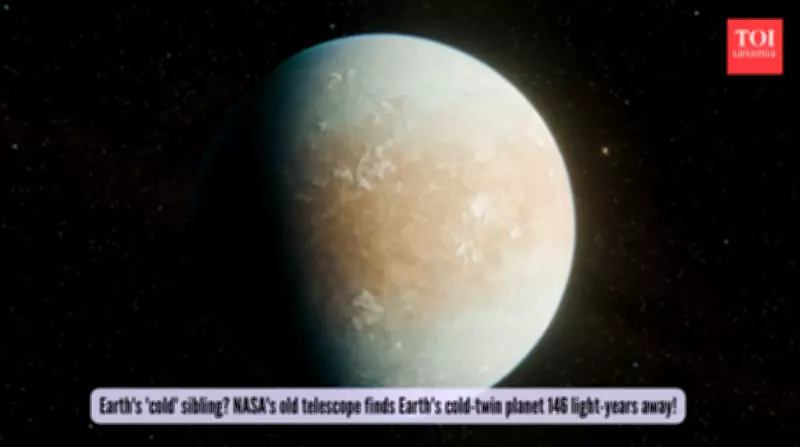
NASA Uncovers 'Cold Earth' Exoplanet in Retired Telescope Data
Is there life beyond our planet? This profound question has captivated humanity for generations, driving scientific exploration into the cosmos. In a remarkable breakthrough, NASA researchers have discovered an intriguing exoplanet that offers new clues in this eternal quest.
Discovery from Historical Archives
NASA scientists recently unearthed HD 137010 b, an Earth-sized planet detected through meticulous analysis of retired Kepler telescope data. The discovery emerged from a single transit signal in Kepler's K2 observations from 2018, demonstrating that old astronomical archives continue to yield hidden treasures. Published in The Astrophysical Journal Letters in January 2026, this finding highlights how advanced analytical techniques can extract valuable information from historical datasets.
The planet orbits a bright K-dwarf star located approximately 146 light-years from Earth, completing its orbit every 355 days. Slightly larger than our home planet, HD 137010 b required extensive verification using high-precision instruments including HARPS, Hipparcos-Gaia data, and Gemini South telescope images to confirm its existence beyond any doubt.

Characteristics of the 'Cold Earth'
Dubbed the 'cold Earth' by astronomers, HD 137010 b occupies the outer edge of its star's habitable zone. Due to its cooler host star, the planet receives only about one-third of the sunlight that Earth enjoys, resulting in equilibrium temperatures hovering around -68°C - even colder than Mars' average temperatures.
Despite these frigid conditions, planetary models suggest a 40-51% probability that liquid water could exist on HD 137010 b. This potential arises from the possibility of a carbon dioxide-rich atmosphere creating greenhouse warming effects. The planet shares several key characteristics with Earth:
- Rocky composition similar to terrestrial planets
- Earth-like orbital period of approximately one year
- Location within the habitable zone, though at its colder boundary
Unlike the numerous 'hot Jupiter' exoplanets commonly discovered, this represents a rare find of an Earth-analog world that could potentially support certain conditions for life.
Future Research Opportunities
At just 146 light-years distant with a Sun-like host star, HD 137010 b presents an ideal target for detailed follow-up studies. Next-generation telescopes including the James Webb Space Telescope and the upcoming Nancy Grace Roman Space Telescope could potentially analyze its atmosphere for biosignatures - chemical indicators of biological activity.
The planet's year-long orbit means transit events are infrequent, but observatories like TESS (Transiting Exoplanet Survey Satellite) or CHEOPS (Characterising Exoplanet Satellite) might capture additional glimpses. While confirmation of certain characteristics remains pending, multiple data sources strongly suggest HD 137010 b represents a genuine planetary discovery rather than a false signal.
Scientific Implications and Questions
HD 137010 b presents a fascinating hybrid world - partially resembling Earth in its rocky composition and orbital characteristics, yet partially similar to Mars in its frozen surface conditions. Scientists can now test whether a thick atmosphere could trap sufficient heat to maintain liquid water far from its host star, potentially refining our understanding of habitable zone boundaries.
Key questions emerging from this discovery include:
- Could subsurface oceans exist beneath surface ice layers?
- What atmospheric composition would be necessary to maintain liquid water?
- How does this discovery expand our definition of potentially habitable worlds?
While no definitive answers exist yet, HD 137010 b provides a valuable natural laboratory for testing theories about planetary habitability under extreme conditions.

The Power of Historical Data Mining
Eight years after the Kepler mission's conclusion, this discovery demonstrates the continuing value of what astronomers sometimes call 'zombie data' - archived observations that yield new insights through advanced analytical methods. Single transit detections are particularly challenging to confirm, but sophisticated analysis techniques are now unlocking these subtle signals.
This breakthrough suggests that archives from other retired and active telescopes - including Hubble, Spitzer, and eventually JWST - likely contain undiscovered exoplanets waiting to be revealed. Such data mining approaches enable continued exoplanet discovery without requiring new space telescope launches, maximizing the scientific return from previous investments in space exploration.
The discovery of HD 137010 b represents more than just another exoplanet catalog entry - it exemplifies how persistent scientific inquiry, combined with innovative data analysis, continues to expand our understanding of the universe and our place within it.