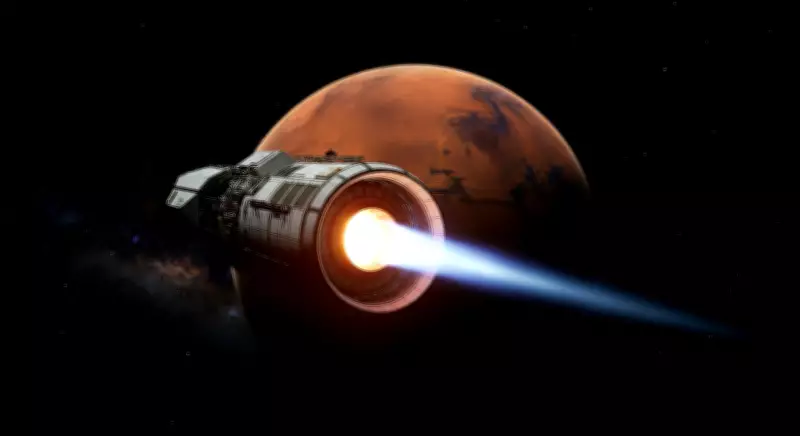
NASA has achieved a significant milestone in deep space propulsion with a recent test of a new magnetoplasmadynamic (MPD) thruster at the Jet Propulsion Laboratory (JPL) in Southern California. The technology, which could propel crewed missions to Mars and robotic spacecraft throughout the solar system, was put to the test in February 2026, setting a new US power record of 120 kilowatts.
A Leap Toward Mars
For decades, the central obstacle to crewed deep space travel has been the physics of chemical rockets, which require enormous amounts of fuel to move a spacecraft across hundreds of millions of kilometers. The JPL test suggests that this gap is finally beginning to close. While a Mars mission is not imminent, the demonstration makes one plausible in a way that even cautious engineers find difficult to dismiss.
The Test Details
On February 24, 2026, engineers fired the MPD thruster five times in a specialized water-cooled vacuum chamber at JPL's Electric Propulsion Lab. The tungsten electrode at the thruster's center burned bright, reaching temperatures above 2,800 degrees Celsius. The tests successfully set a new US record of 120 kilowatts of power, estimated to be 25 times greater than the thrusters aboard NASA's Psyche spacecraft, which currently has the most powerful electric thrusters NASA has ever flown.

What Makes This Thruster Different
Electric propulsion is not new to NASA. The agency already uses solar electric thrusters on missions like Psyche, which cut propellant use by up to 90% compared to chemical rockets. However, conventional electric thrusters use electric fields to accelerate ions, while MPD engines harness both electric currents and magnetic fields to generate thrust, enabling significantly higher power operation. The lithium metal vapor propellant, which burns at extreme temperatures, allows the system to handle power inputs that would destroy conventional designs.
The concept behind MPD thrusters dates back to the 1960s, but turning theory into a viable propulsion system has taken decades. The JPL test demonstrates that engineering has finally caught up with the physics.
The Numbers Behind a Mars Mission
The February test was a proof of concept, not a finished product. NASA aims to reach power levels between 500 kilowatts and 1 megawatt per thruster in the coming years. A future human mission to Mars will require 2 to 4 megawatts of power, consisting of several thrusters and requiring more than 23,000 hours (roughly 958 days, or 2.6 years) of continuous operation. The 120-kilowatt result validates the core approach and confirms stable operation at record power levels.
Why Getting to Mars Faster Matters
Faster Mars transit is a medical and operational necessity. Every additional day in deep space increases cosmic radiation exposure, muscle deterioration, psychological strain, and the probability of mechanical failure. Electric propulsion builds speed gradually, but after a week in space, a spacecraft using this system could reach over 400,000 kilometers per hour, compressing journey times in ways chemical rockets cannot match without impractical fuel loads.
This breakthrough brings humanity one step closer to setting foot on Mars, and the engineering community is watching closely as further tests unfold.