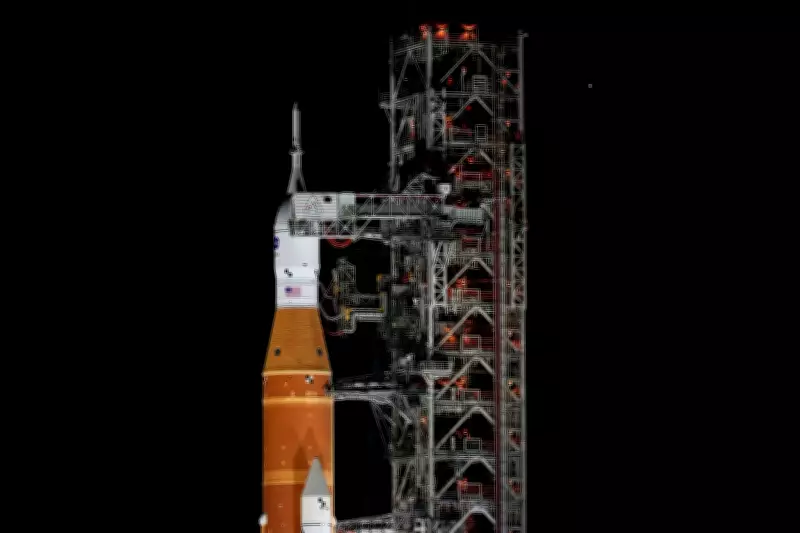
NASA has terminated the critical wet dress rehearsal for the Artemis II mission at the T-5:15 minute mark after launch teams detected a concerning liquid hydrogen leak during the final phase of the test. This significant development occurred as the mission entered terminal count, the crucial period when automated systems take control and the rocket transitions to internal power ahead of a simulated engine start.
Hydrogen Leak Detection and Immediate Response
The issue manifested at the precise interface between the massive Space Launch System rocket and the tail service mast umbilical, an area that had already displayed elevated hydrogen levels earlier in the countdown process. Given liquid hydrogen's highly flammable nature, the launch team immediately halted the rehearsal to prevent any potential safety hazards.
Following the abrupt stop, launch controllers swiftly began securing the vehicle and preparing to drain propellants from the tanks. This careful procedure ensures the rocket remains in a safe condition while engineers assess the technical situation.

Understanding the Wet Dress Rehearsal
This comprehensive exercise, known as a wet dress rehearsal, is meticulously designed to mirror an actual launch scenario as closely as possible without actually lifting off. During the final ten minutes of the countdown, automated systems assume control, the rocket switches to internal power, and final checks are executed as if the engines were about to ignite.
The halt at T-5:15 does not indicate a major failure but rather demonstrates NASA's robust safety protocols. It signifies that the issue was detected early in the process, allowing engineering teams to address and resolve it long before astronauts would ever be on board for the actual mission.
Countdown Timeline and Structure
The countdown clock initiated at 8:13 p.m. Eastern Standard Time, corresponding to 6:43 a.m. Indian Standard Time. This marked L-48 hours and 40 minutes ahead of a simulated launch window scheduled to open at 9 p.m. EST on Monday, February 2, or 7:30 a.m. IST on Tuesday, February 3.
NASA's sophisticated countdown follows a dual-structure system built around both "L minus" and "T minus" times:
- L-minus tracks the time remaining until liftoff
- T-minus tracks the precise sequence of events leading up to launch
Teams can strategically pause the clock to manage critical tasks or align with target windows. During these holds, the T-minus clock stops while L-minus continues running, providing operational flexibility.
As part of the rehearsal protocol, teams planned to pause briefly at T-1 minute and 30 seconds, resume the count, then stop again at T-33 seconds. The clock would then recycle back to T-10 minutes for a second terminal countdown, ending once more at T-33 seconds. This sequence accurately mirrors real launch conditions, including scenarios where a launch might be delayed or scrubbed for technical reasons.
Crew Milestones Practiced Without Astronauts
Although the Artemis II astronauts were not physically present during the wet dress rehearsal, several crucial crew-related milestones were still meticulously rehearsed as part of the comprehensive countdown flow. Ground teams practiced tasks that would normally occur on actual launch day, including procedures typically executed by the Artemis closeout crew.
These essential steps include:
- Sealing the Orion crew module
- Closing the launch abort system hatches before terminal count begins
NASA emphasizes that running through these critical actions during the rehearsal helps validate the overall launch timeline and ensures all systems function harmoniously when astronauts are eventually on board.
Next Steps and Mission Significance
Once the test concludes completely, propellants will be systematically drained from the rocket's tanks, and engineers will thoroughly review all collected data before setting a formal launch target for Artemis II. This mission represents a historic milestone as the first crewed mission of NASA's ambitious Artemis lunar program, which aims to return humans to the Moon and establish sustainable lunar exploration.

The wet dress rehearsal serves as a vital validation exercise for both systems and procedures, ensuring that every component functions flawlessly before committing to an actual launch with astronauts aboard. While technical challenges like the hydrogen leak require immediate attention, they also demonstrate the rigorous testing protocols NASA employs to guarantee mission safety and success.