NASA's SPHEREx Telescope Captures Rare Outburst of Interstellar Comet 3I/ATLAS
In a remarkable astronomical event, NASA's SPHEREx space telescope has documented an extraordinary outburst from interstellar comet 3I/ATLAS as it departed our solar system in December 2025. Unlike typical comets that fade after passing the Sun, this rare visitor from beyond our stellar neighborhood flared up dramatically, providing scientists with an unprecedented chemical snapshot of material formed around another star.
An Unexpected Eruption in Deep Space
By December 2025, comet 3I/ATLAS was already exiting the inner solar system, having made its closest approach to the Sun two months earlier. Normally, cometary activity peaks during solar proximity when heat causes ices to vaporize. However, this interstellar object defied expectations by erupting brightly during its outward journey.
NASA's SPHEREx, the Spectro-Photometer for the History of the Universe, Epoch of Reionization and Ices Explorer, captured the event in infrared light. The telescope observed the comet brightening significantly as it threw off substantial amounts of gas and dust into interplanetary space.

Scientific Insights from the Outburst
Lead study author Carey Lisse from Johns Hopkins Applied Physics Laboratory in Laurel, Maryland, described the comet as "full-on erupting" even after its solar flyby. Remarkably, water ice was sublimating into gas far from the Sun's immediate influence.
Co-author Phil Korngut explained that the comet likely developed a radiation-processed shell during its extensive journey between stars. Beneath this protective layer, pristine ices remained preserved until the outburst released them.
Chemical Composition Revealed
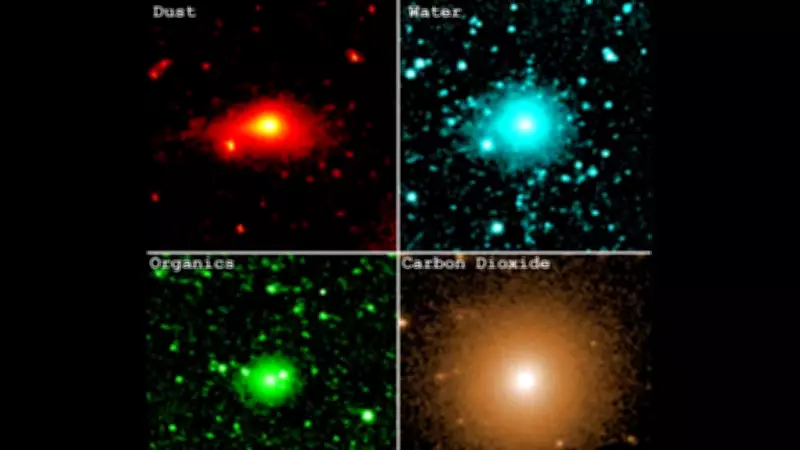
SPHEREx's observations detected multiple compounds streaming from comet 3I/ATLAS:
- Water vapor
- Carbon dioxide
- Methane
- Methanol
- Traces of cyanide
- Various organic molecules
The comet developed a glowing coma rich in these ingredients and formed a distinctive pear-shaped dust tail as rocky fragments were ejected into space.
Rarity of Interstellar Visitors
Comet 3I/ATLAS represents only the third confirmed interstellar object ever observed in our solar system, following:
- 1I/'Oumuamua discovered in 2017
- 2I/Borisov identified in 2019
This latest visitor offers what may be the clearest examination yet of alien ice originating from beyond our Sun's family of planets and comets. The unexpected outburst provided astronomers with a unique opportunity to study pristine material that formed around another star, offering insights into chemical processes occurring in distant planetary systems.
The SPHEREx observations continue to provide valuable data as scientists analyze the composition and behavior of this rare interstellar visitor, expanding our understanding of materials that travel between star systems across the galaxy.