NASA's Athena Supercomputer: Compressing Centuries of Work into a Single Day
For the average individual, a powerful computer typically translates to faster loading times or smoother video editing capabilities. However, for NASA, computational power means something far more profound: the ability to compress centuries of work into a mere 24 hours. This is the groundbreaking promise behind Athena, the space agency's newest and most powerful supercomputer, which was officially unveiled in January 2026.
The Unassuming Powerhouse at Ames Research Center
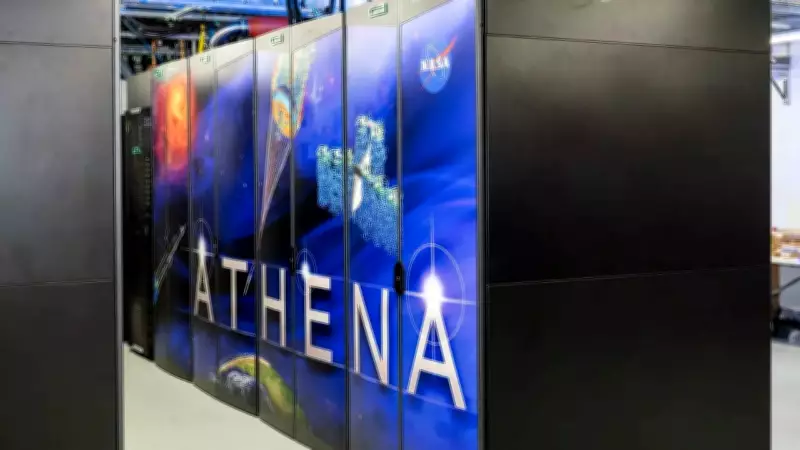
Residing quietly at the Ames Research Center in California, Athena does not present a dramatic visual spectacle. There are no flashing lights or sci-fi glows to capture attention. Instead, it consists of orderly rows of hardware humming away with quiet efficiency. Despite its understated appearance, experts confirm that this supercomputer can accomplish in a single day what an average home personal computer would require approximately 500 years to complete.
This staggering performance gap highlights precisely why Athena matters so much at a time when space missions are becoming increasingly complex, data volumes are exploding exponentially, and guesswork is no longer a viable option in space exploration.

Setting New Benchmarks in Speed and Performance
NASA's Athena supercomputer establishes a new benchmark in computational speed and performance capabilities. Athena delivers more than 20 petaflops of peak performance, a figure that might sound abstract but represents extraordinary computational power. To put this in perspective, one petaflop equates to one quadrillion calculations every single second. Athena achieves this remarkable feat twenty times over.
This performance level places Athena significantly ahead of NASA's older supercomputing systems, including the venerable Pleiades and Aitken machines that have served the agency faithfully for many years. While those systems were powerful in their time, Athena represents a quantum leap forward in computational capability.
Modular Design for Future Evolution
The system operates within NASA's innovative Modular Supercomputing Facility, a space specifically designed for maximum flexibility and adaptability. This modular approach allows for:
- Easy upgrading of hardware racks
- Simple swapping of components as technology advances
- Adjustments to cooling systems without requiring major structural changes
This flexibility matters more than it might initially appear. Supercomputers typically age rapidly in the fast-moving world of technology, but Athena is engineered to evolve gracefully rather than requiring complete replacement. NASA officials emphasize that this strategic approach helps maintain high capability while keeping operational costs manageable, with the added benefit of minimizing disruptive interruptions to critical research activities.
Balancing Extreme Power with Energy Efficiency
Athena was designed from the ground up to deliver extreme computational performance without corresponding extreme energy waste. The modular setup facilitates superior airflow and cooling efficiency, which reportedly reduces utility demands significantly compared to older supercomputing facilities.
This energy-conscious design addresses a critical concern in high-performance computing: when power bills spiral out of control, research inevitably slows down. Athena successfully avoids this trap by striking an optimal balance between raw computational power and sustainability—a consideration that space agencies and research institutions can no longer afford to ignore.
There's also a less visible but equally important benefit: reduced heat generation means less stress on hardware components, resulting in longer operational lifespans. While not particularly flashy, this characteristic proves crucial for maintaining consistent research capabilities over extended periods.
Transforming Rocket Simulations and AI Research
Athena isn't merely crunching numbers for theoretical purposes. The supercomputer is actively being deployed to simulate rocket launches with remarkable precision that was previously unattainable. Engineers can now execute thousands of "what if" scenarios during the design phase, long before any metal is even cut for physical prototypes.

Artificial intelligence represents another major focus area for Athena's capabilities. NASA is utilizing the supercomputer to train large-scale AI models that analyze massive datasets from diverse domains including:
- Earth observation and monitoring systems
- Climate system modeling and analysis
- Aeronautics research and development
Reducing Risk in Mission Planning and Navigation
The computational power of Athena directly contributes to reducing risks in critical space mission planning and navigation activities. Consider these essential applications:
- Lunar lander development and testing
- Mars entry system design and validation
- Trajectory planning for deep-space probes and missions
In all these areas, even tiny miscalculations can lead to mission failure, making Athena's precision capabilities invaluable. Asteroid path tracking represents another computationally intensive task that benefits from Athena's power. The calculations involved in monitoring near-Earth objects are both immense and continuous, where small changes in trajectory data can have significant implications. Athena can process these updates rapidly, helping NASA refine impact predictions with greater accuracy and timeliness.
The supercomputer system is managed by NASA's Office of the Chief Science Data Officer and fits strategically into the agency's broader hybrid computing strategy, which combines various computational resources to maximize research effectiveness across different scientific domains.