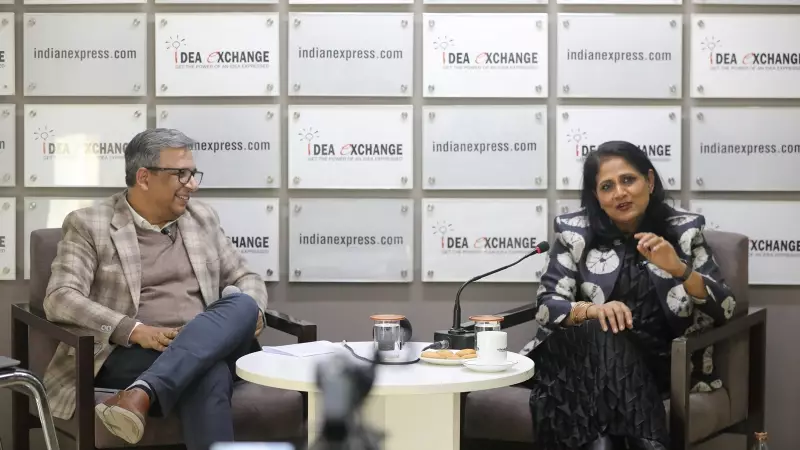
Astrophysicist Priyamvada Natarajan Calls for Shift from Short-Termism to Long-Term Thinking
In a compelling conversation, Priyamvada Natarajan, the Joseph S and Sophia S Fruton Professor of Astronomy and Professor of Physics at Yale University, highlighted the critical need to move beyond short-term obsessions and embrace a future-oriented mindset. As one of the world's leading astrophysicists, her insights delve into the mysteries of the universe, the transformative potential of artificial intelligence, and the challenges facing scientific research in India.
The Golden Age of Astrophysics: Confluence of Ideas and Instruments
Natarajan emphasized that astrophysics is experiencing a golden age, driven by a unique alignment of advanced instruments and innovative ideas. Space telescopes like Hubble, Chandra, and James Webb have revolutionized our ability to observe the cosmos in different wavelengths, free from Earth's atmospheric distortions. Combined with leaps in computing power, these tools enable simulations of the universe and sophisticated conceptual models, making astrophysics a pioneer in big data science.
Unraveling Cosmic Mysteries: Dark Matter, Black Holes, and Beyond
When asked about dark matter, Natarajan admitted there is no easy explanation, noting its peculiar nature as matter that interacts only gravitationally. She expressed optimism for breakthroughs in understanding dark matter, black holes, and dark energy, driven by improved observational and computational capabilities. However, she cautioned that serendipity often plays a key role in scientific discovery, making the future hard to predict.

AI's Transformative Role in Science and Creativity
Natarajan acknowledged that AI is set to be a transformative force in fundamental research and daily life. While it may enhance processes, she questioned whether AI could replicate the human creativity and intuition behind groundbreaking scientific questions. The big uncertainty lies in how AI will impact the creative arc of discovery, though its influence on research methodologies is inevitable.
Building a Research Ecosystem in India: Challenges and Opportunities
Discussing India's potential, Natarajan pointed out that while the country boasts immense talent and institutions, it lacks a well-established research ecosystem akin to the US. Key constraints include the absence of a collaborative environment, sustained funding, and a mindset shift towards scientific temper. She stressed the importance of creating catalyst points for interaction, such as workshops and conferences, to foster innovation and attract global talent.
Overcoming Short-Termism for Future Generations
Natarajan critiqued society's regression into short-termism, fueled by technologies like social media that reduce attention spans. She urged a move away from this obsession with immediate returns, advocating for long-term thinking in resource utilization and planetary stewardship. In her vision, future universities should replace departmental silos with interdisciplinary vertices to drive breakthroughs across fields.
Her call to action resonates deeply: we must prioritize knowledge production, respect scientists, and invest in sustained research to secure a brighter future for generations to come.