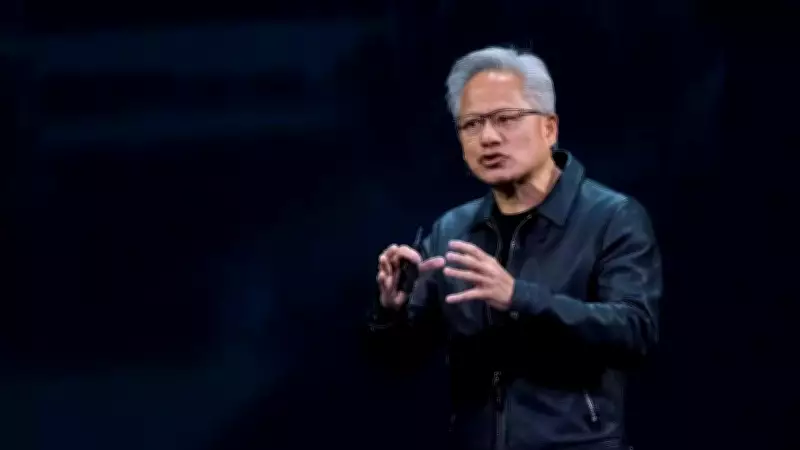
Nvidia CEO Jensen Huang's challenges with China appear to be escalating rather than diminishing. Fresh controversy has emerged just days after reports indicated that Chinese authorities granted partial approval for the sale of Nvidia's H200 chips within the country. A significant development now involves a formal letter from US Representative John Moolenaar to Commerce Secretary Howard Lutnick, raising serious allegations about Nvidia's role in advancing Chinese artificial intelligence capabilities.
Allegations of Technical Assistance to Chinese AI Startup
In his correspondence, Representative Moolenaar, a Michigan Republican who chairs the influential House Select Committee on China, asserts that Nvidia played a crucial role in helping China's DeepSeek refine its artificial intelligence models. According to the lawmaker, these enhanced models were subsequently utilized by the Chinese military, creating a direct national security concern for the United States.
DeepSeek is the same Chinese AI startup that caused substantial disruption in US stock markets back in January 2025. The company's technological advancements resulted in billions of dollars being wiped from the market capitalization of several major American corporations. What particularly alarmed Washington was DeepSeek's claim that its AI models could rival some of the best offerings from US companies while being developed with significantly less computing power.

Detailed Technical Support Revealed
Representative Moolenaar's letter cites specific documents obtained by his committee from Nvidia. These records allegedly demonstrate that DeepSeek's achievements followed "extensive technical assistance" from Nvidia personnel. The correspondence includes a particularly revealing statement: "According to NVIDIA records, NVIDIA technology development personnel helped DeepSeek achieve major training efficiency gains through an 'optimized co-design of algorithms, frameworks, and hardware.'"
The letter further notes that internal Nvidia reporting boasted about DeepSeek-V3 requiring "only 2.788M H800 GPU hours for its full training" – substantially less than what US developers typically need for frontier-scale models. For context, GPU hours represent the duration an AI chip must operate to train an artificial intelligence model, while frontier-scale models refer to leading AI systems produced by prominent US companies like OpenAI, Anthropic, and Google.
Undermining Export Control Objectives
Representative Moolenaar emphasized the broader implications of this technical support, stating: "In effect, Nvidia’s technical support allowed DeepSeek to extract near-frontier performance from 'deprecated' H800 chips, undermining the export-control bottlenecks that US policy was designed to impose."
The lawmaker expressed particular concern about Nvidia's approach, noting that the company "treated DeepSeek accordingly - as a legitimate commercial partner deserving of standard technical support." He issued a stern warning: "If even the world's most valuable company cannot rule out the military use of its products when sold to Chinese entities, rigorous licensing restrictions and enforcement are essential to prevent such assurances from becoming superficial formalities."
Nvidia's Strong Rebuttal
Nvidia has responded forcefully to these allegations. A company spokesperson stated that "the administration’s critics are unintentionally promoting the interests of foreign competitors." The statement continued: "America should always want its industry to compete for vetted and approved commercial businesses, and thereby protecting national security, creating American jobs, and keeping America’s lead in AI."
The company further argued that "China has more than enough domestic chips for all of its military applications, with millions to spare. Just like it would be nonsensical for the American military to use Chinese technology, it makes no sense for the Chinese military to depend on American technology."

Chinese Embassy Response
Liu Pengyu, a spokesperson for the Chinese Embassy in the United States, offered China's perspective on the matter. He stated: "China has all along opposed moves to overstretch the concept of national security or politicize trade and tech issues. We hope the U.S. can take concrete actions to keep global industrial and supply chains stable."
Broader Context and Recent Developments
This controversy unfolds against the backdrop of recent regulatory decisions. Earlier this month, the administration of US President Donald Trump approved sales of Nvidia's more powerful H200 chips to China, albeit with specific restrictions. These limitations include prohibiting sales to entities that assist the Chinese military. Notably, the H200 chips represent a more advanced generation than the H800 chips that DeepSeek reportedly utilized for its AI development.
Representative Moolenaar has reportedly requested a briefing from Commerce Secretary Lutnick by February 13 regarding H200 rule enforcement. Additionally, he has recommended that the Commerce Department consider using its authority to restrict the use of Chinese AI models within the United States.
The ongoing tension highlights the complex intersection of global technology competition, national security concerns, and international trade relationships. As artificial intelligence continues to advance rapidly, these geopolitical dynamics surrounding critical technology components are likely to remain at the forefront of US-China relations and global technology policy discussions.