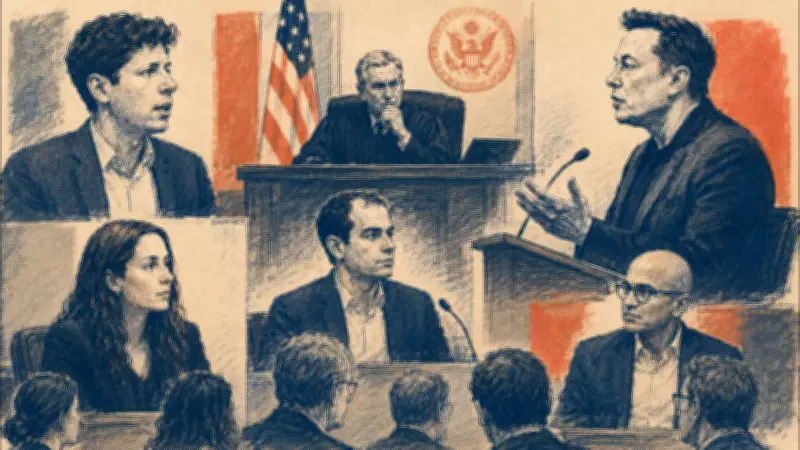
On the Wednesday of the trial's third week, before the jury was let in, an OpenAI lawyer walked up to the bench with a small object wrapped in white cloth. Judge Yvonne Gonzalez Rogers unwrapped it on the desk in front of her. It was a gold statue, about the size of a Little League trophy, depicting the rear half of a donkey mounted on a small white base. The inscription read: "Never stop being a jackass for safety." The judge looked at it and set it down. "I don't want it," she said.
The trophy belonged to Josh Achiam, OpenAI's chief futurist, who joined the company as an intern in 2017. He testified later that morning about an all-hands meeting in early 2018, where Elon Musk announced he was leaving OpenAI to pursue AGI at Tesla. Achiam had spoken up, saying racing for AGI sounded reckless. By Achiam's account, Musk snapped and called him a jackass in front of fifty or sixty people. At the next all-hands, Dario Amodei and a colleague presented Achiam with the trophy, hand-engraved.
Musk, who testified in week one, had denied under oath that he ever called anyone at OpenAI a jackass. He admitted to using "strong language" and possibly saying "don't be a jackass," but not as a label aimed at a person. OpenAI's lawyers wanted the statue in evidence to address this question. The judge ruled the testimony could come in, but the trophy could not. The jury never saw it, though photographs leaked out of the courtroom.

Key Witnesses and Testimonies
Part one of this trial covered Musk's testimony, where he produced over 200 instances of "I don't recall" under cross-examination. Weeks two and three focused on people around the principals, including former CTOs, board members, and a chief scientist who has not spoken to his CEO in over a year.
Shivon Zilis: The Mother of Musk's Children
Shivon Zilis served on OpenAI's board from 2020 to 2023 and advised the lab since 2016. She is the mother of four of Musk's children, three of them by IVF after a one-off romantic encounter. She originally signed on as a co-plaintiff but dropped out before trial. In week two, she testified in a black cardigan and black jeans, speaking in a small voice. Her job for Musk was to find bottlenecks across his AI portfolio and solve them, working 80 to 100 hours a week. She called this his "maniac mode."
Zilis had been the only person taking proper notes during the cofounder negotiations of 2017 and 2018, making her emails the most-quoted exhibits. OpenAI's lawyer Sarah Eddy walked her through them one at a time. A 2017 brainstorming email listed structural options for OpenAI, including "switch to for profit in next couple of weeks (woah fast!)." Another email explained that cofounders demanded an "ironclad agreement to not have Elon (or anyone) have absolute control of AGI." A third from August 2017 flagged that Musk had silently halted his quarterly donations, two weeks before he told them.
Other documents showed Zilis floating the idea of folding OpenAI into Tesla and asking whether they could "find a way to get Demis" Hassabis of DeepMind. The exhibit that produced the longest silence came from February 2018, when Zilis asked Musk: "Do you prefer I stay close and friendly with OpenAI to keep info flowing or begin to disassociate? Trust game is about to get tricky." Musk replied: "Close and friendly, but we are going to actively try to move three or four people from OpenAI to Tesla." Zilis told the jury she meant to write "trust framework," not "trust game."
In February 2023, as word leaked that Musk was building a rival AI lab, Zilis texted a friend about her impending resignation from the OpenAI board: "When the father of your babies starts a competitive effort and will recruit out of OpenAI there is nothing to be done." Her friend suggested Musk put her on the board of the new thing. Zilis said she was bummed. In closing arguments, Eddy summarized: "Even the mother of his children can't back his story."

Sam Altman's Testimony and Allegations
Sam Altman survived four hours on the stand, but damage came from witnesses who weren't there. Mira Murati, former CTO, did not appear in person; her deposition played in court. She described an incident where Altman told her OpenAI's legal team had cleared a new AI model from going through the deployment safety board. She called the head of legal directly, who said no such thing happened. Asked if Altman was telling the truth, Murati said flatly: "No." Her text exchanges from November 2023 included Altman asking "Can you indicate directionally good or bad?" and Murati replying "Directionally very bad. Sam this is very bad."
Helen Toner, former board member who voted to fire Altman, described a "pattern of behavior" related to his "honesty and candor." She also said Murati had been "strikingly unsupportive" and "remarkably passive" after the firing. Tasha McCauley used the phrase "toxic culture of lying." Safety researchers Rosie Campbell and Daniel Kokotajlo testified about their concerns.
When Steven Molo, Musk's lawyer, cross-examined Altman, he read aloud a list of seven people who built OpenAI with Altman or worked closely under him, all of whom have publicly described him as dishonest. Altman, in a navy suit and lavender tie, told the jury he believed himself to be an honest businessman. He also walked back a 2023 statement to the U.S. Senate, admitting he held equity in OpenAI via Y Combinator, and disclosed a roughly $1.6 billion personal stake in Helion, a $600 million stake in Stripe, and stakes in Reddit and Cerebras, all companies with deals with OpenAI.
By Tuesday evening, the U.S. House Oversight Committee opened a probe into Altman's potential conflicts of interest ahead of OpenAI's planned IPO. Six Republican state attorneys general wrote to the SEC asking for scrutiny. The Wall Street Journal published a detailed investigation.
Ilya Sutskever: The Chief Scientist
Ilya Sutskever, OpenAI's chief scientist, took the stand on Monday of week three in a blue button-down shirt with no jacket. He spoke softly and made little eye contact. He has not spoken to Altman in over a year or to Brockman in over fifteen months. OpenAI's lawyer treated him as a hostile witness. Two key disclosures emerged: his vested shares in OpenAI's for-profit arm are worth about $7 billion, and he confirmed every line of a 52-page memo accusing Altman of "a consistent pattern of lying" and "undermining his execs." He had collected evidence for a year before the November 2023 firing but did not show it to Altman because he felt Altman would "find a way to make them disappear." He justified flipping to support Altman's return as panic: "I felt that, had I not done this, the company would have been destroyed."
The most striking moment came when Judge Gonzalez Rogers asked Sutskever to compare AI of 2018 to today. He replied: "I would describe it as the difference between an ant and a cat." OpenAI's lawyers later put up an image of an ant beside a cat on the courtroom screen.
Satya Nadella: Microsoft's CEO
Microsoft is technically a defendant, accused by Musk of aiding OpenAI's alleged breach of charitable trust. Satya Nadella testified on Monday, May 11, saying he was "very proud" Microsoft invested in OpenAI and that he never received a complaint from Musk. He expressed annoyance about the November 2023 firing, saying he repeatedly asked the board for specifics and never got any: "It was sort of amateur city, as far as I'm concerned." A 2022 internal email surfaced where Nadella wrote: "I don't want to be IBM and OpenAI to be Microsoft." He explained he meant Microsoft should retain self-sufficiency. He conceded that by 2023, Microsoft projected $92 billion in returns on a $13 billion investment.
Closing Arguments and Jury Deliberation
Closing arguments began Thursday morning with a forty-minute argument about a television. Steven Molo had wheeled a 36-inch monitor into the courtroom without coordinating with OpenAI's lawyers. The judge reminded him to talk to the other side. OpenAI's team said they didn't have the cable. Eventually, a lawyer carried the TV out upside down.
Molo's closing ran two hours. He referred to Brockman as "Greg Altman," told the jury Musk was not asking for money (the judge corrected that Musk seeks $134 billion in damages), and used a metaphor about a wooden bridge built on "Sam Altman's version of the truth." Sarah Eddy for OpenAI showed Musk floating a for-profit conversion in 2017, demanding majority equity, and souring when not given control. She used the "even the mother of his children" line and finished in under fifty minutes. William Savitt noted Musk used "I don't recall" 150 to 200 times and said Musk was "in parts unknown"—he was in Beijing, having flown out with Donald Trump on Air Force One during week three, in apparent defiance of a judge's order to remain on recall. His lawyer apologized. The judge said nothing on the record.
The jury begins deliberations on Monday. The verdict is advisory; Judge Gonzalez Rogers will decide legal questions and rule on remedies if Musk wins. Musk wants $134 billion redirected to OpenAI's nonprofit, Altman and Brockman removed, and OpenAI's for-profit structure unwound. OpenAI wants to proceed toward an IPO that could value the company at over a trillion dollars.
The trial has produced a record of how the people running the most powerful technology behave when they think nobody is watching. They keep diaries, text each other "directionally very bad," commission small gold trophies of donkeys' backsides, negotiate equity structures over whiskey, and threaten each other by SMS. The donkey trophy is back in OpenAI's lawyer's office. The judge has confirmed she does not want it. Whichever way the jury rules, somebody will have to find somewhere to put it.