

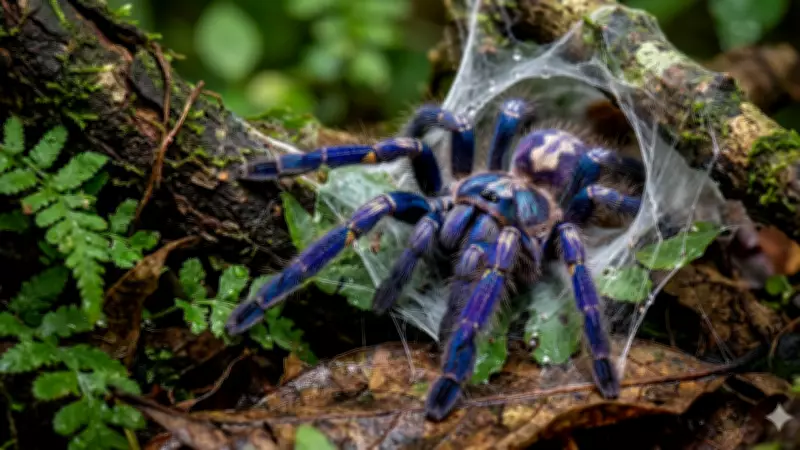
The critically endangered Peacock Tarantula, scientifically known as Poecilotheria metallica, has gained significant attention in the Eastern Ghats due to the conservation efforts led by Pawan Kalyan, the Deputy Chief Minister of Andhra Pradesh. This highly endangered tarantula is endemic to a specific region of Andhra Pradesh and faces severe threats from habitat destruction, illegal trade, and ecological imbalances.
Pawan Kalyan's Role in Peacock Tarantula Conservation
The focus on the Peacock Tarantula is not a coincidence. Pawan Kalyan has been instrumental in raising awareness about this species and bringing it into the limelight. In a public announcement, he referred to the spider as a rare gem of the Eastern Ghats that is finally receiving its due attention. While the statement may seem symbolic, the intent behind the announcement is clear from the upcoming initiative to scientifically survey the species in the Nagarjunasagar Srisailam Tiger Reserve (NSTR). This survey will help map the distribution and population of the species, which remain largely unknown.
Pawan Kalyan reiterated his conservation philosophy through a post on X, stating that conservation is not only about protecting big, charismatic species but also rare, endemic, and irreplaceable ones. This reflects a shift in conservation thought in India, where species other than tigers and elephants are gaining significance.

The Peacock Tarantula: A Rare Eastern Ghats Species Under Threat
The Peacock Tarantula is one of the most beautiful spiders in the world, identified by its bright metallic blue color. It is also one of the rarest species, existing only in a single patch of forest in Andhra Pradesh, India. Scientific records trace its discovery back to 1898, when a specimen was reported at the British Museum, found near Gooty.
The species is listed as Critically Endangered on the International Union for Conservation of Nature (IUCN) Red List. Several factors threaten its survival, including deforestation, degradation of old-growth forests, and poaching for commercial purposes. The tarantula relies on mature trees with crevices for refuge, and as these trees disappear, so does its habitat.
Ecological Importance of the Peacock Tarantula
Despite its small size, the Peacock Tarantula plays a crucial role in maintaining ecological balance. As a predator, it preys on insects like crickets and grasshoppers, helping to control their populations through natural selection. This function is vital for maintaining healthy forests. Researchers have observed that the presence of the Peacock Tarantula often indicates a healthy forest ecosystem.
Conservation Efforts and the Road Ahead
The conservation survey represents a critical development for saving the species. Conservationists and forest authorities are working to establish a basic framework for studying the population, habitat preferences, and distribution patterns of the tarantula. Determining the population size is imperative before any conservation actions can be taken. The Andhra Pradesh Forest Department, in collaboration with the Eastern Ghats Wildlife Society, has embarked on a conservation status survey for the Peacock Tarantula in the expansive stretch of the Nagarjunasagar Srisailam Tiger Reserve.
Protecting the Overlooked to Preserve the Ecosystem
The example of the Peacock Tarantula demonstrates that conservation can involve creatures much smaller and seemingly insignificant than many would expect. Conservation efforts often require the preservation of small creatures that are vital to maintaining ecological balance. Through their involvement, the ministry has managed to direct attention toward this particular species. However, the future survival of these spiders depends on scientific research and the prohibition of poaching in the wild. Conservation of the rare jewel of the Eastern Ghats is not only beneficial for the spider itself but also for the entire ecosystem that relies on it.






