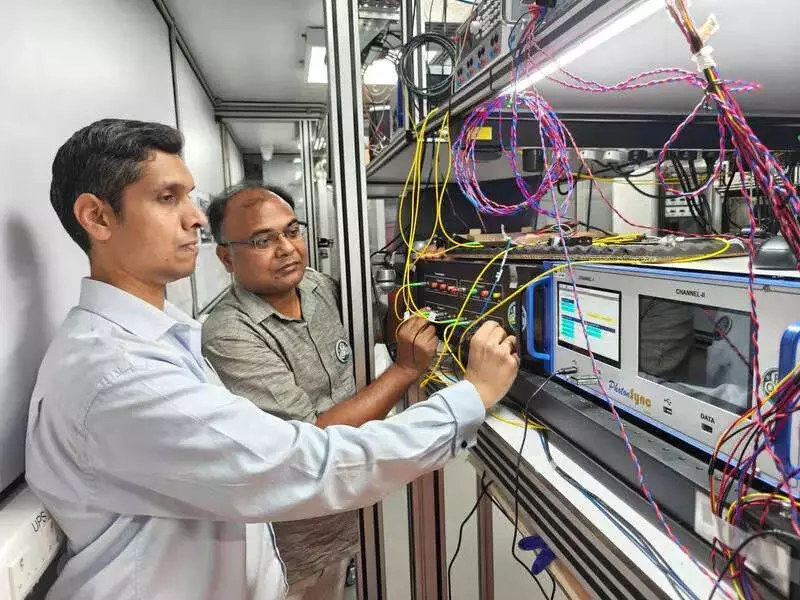
Scientists from Pune have achieved a major technological breakthrough that could transform India's secure communication infrastructure. A team from the Inter-University Centre for Astronomy and Astrophysics (IUCAA) and Jaypee Institute of Information Technology (JIIT) has developed PhotonSync, a new technology that enables standard telecom optical fibers to function as quantum-precision communication channels over distances exceeding 1,000 kilometers.
Overcoming Fundamental Challenges
Optical fibers form the backbone of global internet infrastructure, but their application in quantum communication has faced severe limitations. Two key challenges have historically prevented reliable quantum transmission through these fibers.
First, laser frequency drifts over time create instability. Second, random phase noise from environmental factors like vibrations and temperature fluctuations degrades and often destroys the fragile quantum information traveling through the fiber.

The PhotonSync Solution
Professor Subhadeep De, head of the Precision and Quantum Measurement Laboratory at IUCAA, led the development team that included postdoctoral fellow Stanley Johnson and professor Anirban Pathak from JIIT. They created the PhotonSync hardware entirely within India.
The system stabilizes both the optical fiber and the laser source in real time. It simultaneously controls the phase and frequency of photons traveling through the fiber. The researchers explained their innovative approach.
"We injected a narrow-linewidth laser into the fiber and continuously monitored for frequency drift," they stated. "We applied active phase-noise compensation in real time. Additionally, we retro-reflected light back through the fiber. This returning signal carried complete information about environmental noise, which we dynamically corrected using electronic feedback systems."
Real-World Validation
The team moved beyond laboratory conditions to validate their technology. They deployed a 3.3-kilometer fiber link across the IUCAA campus. They conducted additional tests using 71-kilometer fiber spools.
The experiments demonstrated remarkable results. PhotonSync suppressed phase noise by up to 47.5 decibels. It achieved frequency stability as high as 10⁻¹⁶. These levels are considered optimal for advanced quantum experiments.
Professor De explained the significance of these achievements. "The stability we achieved creates what we call a Phase-Coherent Fibre," he said. "This means standard communication infrastructure can be converted into a quantum-grade channel when needed."
Strategic Implications for India
Beyond its scientific importance, this breakthrough carries major strategic and defense implications for India. It directly supports the government's goal of establishing a nationwide fiber-based quantum communication network spanning nearly 2,000 kilometers.
Professor Pathak highlighted the broader implications of their work. "The Government of India aims to build a fiber-based quantum communication network of about 2,000 kilometers," he noted in a press statement. "This network will include trust nodes. Our research addresses a critical question: Can we perform quantum key distribution over 1,000 kilometers without trusted nodes?"
He continued, "The answer is yes, if twin-field quantum key distribution can be implemented. This approach requires high-quality phase stabilization. Our work specifically addresses this problem. We experimentally demonstrated a phase-stabilization method that is more efficient than existing techniques."
Quantum Security Applications
Quantum key distribution provides information-theoretic security that conventional encryption methods cannot match. This makes it vital for multiple critical applications.
- Defense communications requiring absolute security
- Space missions with sensitive data transmission needs
- Critical infrastructure protection for power grids and financial systems
- Secure government communications at the highest levels
The researchers demonstrated a phase-stabilization method that outperforms existing techniques. This paves the way for long-distance, trust-node-free quantum communication across India's vast geography.

The team has obtained a trademark for PhotonSync. Their work has been published in the international journal Communications Physics. This achievement represents a significant step toward India's quantum communication ambitions and positions the country at the forefront of this critical technology.