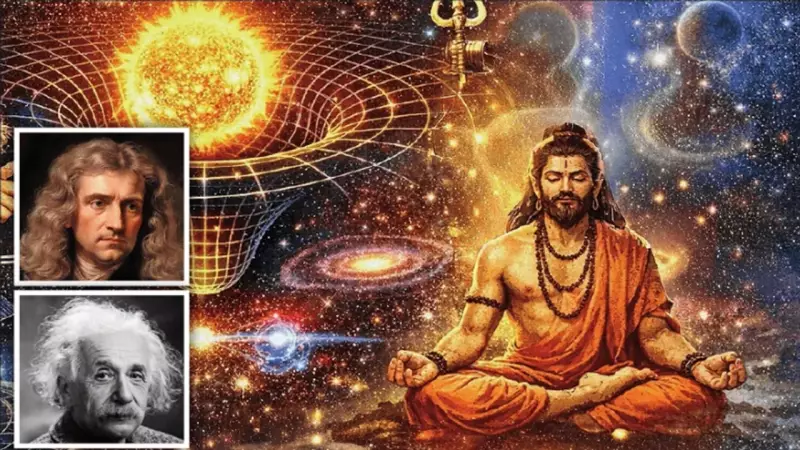
Sir Isaac Newton stands as one of history's most brilliant physicists. Legend tells us he watched an apple fall one morning. This simple observation sparked his revolutionary idea about gravity. He proposed that Earth's gravitational pull brings objects downward.
Newton did not stop there. He formulated the fundamental laws of motion. He conceptualized and quantified the idea of force. His work gave us equations and the Gravitational Constant to calculate gravitational attraction.
Beyond Newton's Three Dimensions
Newton also made significant contributions to optics and developed calculus. Yet, his classical physics operated within a framework of three spatial dimensions. Then came Albert Einstein, another intellectual giant.

Einstein's Theory of Relativity worked across vast astronomical distances. It explained phenomena like time dilation, where a clock on a fast-moving satellite appears slower to a stationary observer. It also described length contraction. This theory introduced the concept of spacetime, a four-dimensional fabric where space and time intertwine as one entity.
Relativity showed that space and time are relative, not absolute. They influence each other. Einstein concluded that Earth orbits the Sun not because of a gravitational force, but because the Sun's immense mass curves the surrounding spacetime.
The Quantum Realm and Its Puzzles
Einstein's theories explained large-scale cosmic phenomena. He also recognized that Newtonian laws break down at the extreme microscopic level. This led to the development of quantum physics, the study of subatomic particles.
Einstein famously disagreed with the Copenhagen interpretation of quantum mechanics. Yet, experimental evidence has consistently supported its predictions. Unlike classical physics, quantum mechanics considers energy, not force, as a fundamental quantity of the universe.
Quantum mechanics is a mathematical framework. Its predictions for subatomic behavior have proven remarkably accurate. A key principle, developed by scientists in Copenhagen, states that one cannot determine the exact path of a particle. One can only calculate the probability of an event. The event materializes only when an observer measures the particle.
The Vedantic Perspective on Reality
Philosophy grapples with fundamental questions of existence. What is ultimate reality? Is the world an illusion? Ancient Vedic seers explored these mysteries. Their insights form the essence of the Upanishads.
They investigated three basic forces: 'Brahm' (the Supreme Soul), 'Jeev' (the individual soul), and 'Jagat' (the material world). The school of 'Shuddh Advaita' or pure non-dualism, articulated by Adi Shankaracharya, holds a profound view. It posits that the world we perceive is an illusion, a superimposition upon the background of 'Brahm'. This is the play of divine consciousness, or 'lila'.
Our minds mistake this illusion for reality due to the limitations of human intellect and sensory perception. This is the concept of 'maya'. Advaita Vedanta distinguishes between a higher and a lower God. The higher God is the formless Absolute, 'Brahm'—an infinite, timeless expanse of pure consciousness and bliss, transcendent and unaffected by worldly phenomena.
The lower God, 'Ishwar', is the creator, sustainer, and dissolver of the world. Ishwar administers the law of Karma, rewarding and punishing beings. His grace can liberate souls from the cycle of birth and death.
Liberation comes from knowledge of our true Self. It is the realization that we are like a wave in the vast ocean of universal consciousness. The external world is not ultimately real. Only conscious energy is real and permanent. Phenomena have no independent existence apart from awareness, which is the true, unchanging reality.
Converging Challenges to Objectivity
The quantum world presents equally puzzling ideas. Its basic assumptions often perplex people. Quantum theory suggests reality is not wholly independent of observation. The observed phenomenon comes into being only when noticed by an observer.
Thus, both quantum physics and Vedantic doctrine challenge the traditional notion of an independent, objective world. They point toward a participatory universe where consciousness plays a crucial role.

Unity in Diversity: A Sanatan View
In the Sanatan (eternal) tradition, God is not a separate entity in the western sense. God is the 'akash' (ether), the substratum of the other four elements. God is the life energy in all beings. The spinning galaxies and spinning electrons represent two ends of the spectrum of this conscious energy.
An analogy describes the individual soul as 'ghataakash'—the space within an earthen pot. The infinite universal consciousness is 'paramaakash'—the endless sky. When the pot breaks, the small 'I' merges with the big 'I'. This sublimation of ego is the final step toward salvation.
Quantum cosmology offers a parallel. It holds that just before the Big Bang, the universe was perfectly symmetrical. All particles had zero mass, existing in an unstable, false vacuum. In quantum physics, a vacuum is not empty space. It teems with latent energy.
Our universe arose like a bubble within this quantum vacuum. Energy condensed into particles. Nuclear reactions and atomic clumping eventually formed celestial bodies, including Earth. This point of creation finds elegant description in the Shvetashvatar Upanishad: 'When there was darkness but neither day nor night, neither cause nor effect, there existed only Shiv, the supreme Lord.'
The world, from these perspectives, is a dynamic chessboard of shifting energies across spacetime. The journey from Newton's apple to quantum probabilities and Vedantic wisdom reveals a continuous quest to understand the very fabric of reality and our place within it.