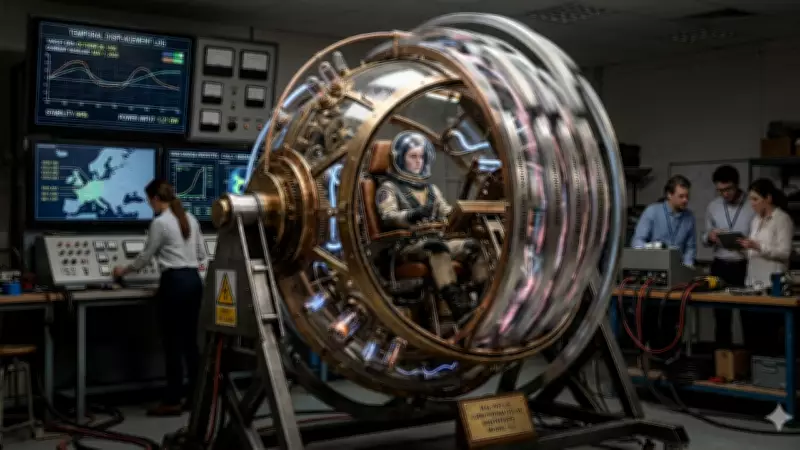
Time travel, closed timelike curves, quantum mechanics, and quantum entanglement have once again become central topics of discussion among scientists who have proposed a new method for sending signals from the present into the past. According to researchers working on quantum communication and spacetime geometry, information could potentially be transmitted backward in time under specific mathematical conditions.
Renewed Interest in Retrocausality
Recent experiments involving photons, quantum particles, and artificially created time loops have reignited interest in retrocausality, quantum mechanics, and Albert Einstein's theories. While scientists emphasize that humanity is far from building a time machine, these experiments are prompting a reevaluation of causality and the nature of time.
How Messages Could Travel Back in Time
The idea of sending information backward through time has long been confined to science fiction, as seen in films like Interstellar, where future humans communicate via gravity and extra dimensions. Physicists are now investigating whether elements of such theories could be realized. One key concept is the closed timelike curve, originally derived from Einstein's general relativity. This hypothetical path through spacetime would allow one to return to an earlier point in time, effectively enabling information to be transported to the past.

Scientists at the Massachusetts Institute of Technology (MIT), including quantum physicist Seth Lloyd, have studied the possibility of mimicking this phenomenon with quantum particles. Their research, titled 'The quantum mechanics of time travel through post-selected teleportation,' suggests that quantum entanglement allows tiny amounts of information to behave paradoxically, breaking conventional cause-and-effect rules. Lloyd previously stated that while humans themselves cannot travel in time, quantum mechanics could enable effective time travel for information.
Quantum Experiments Simulating Time Travel
Experiments simulating time travel have already been conducted within the framework of quantum mechanics. One notable experiment by scientists from the University of Queensland used photons—individual particles of light—to simulate quantum particles traveling through time. The results, published by the American Physical Society, demonstrated the feasibility of such simulations. Physicist Tim Ralph remarked, 'It's interesting that general relativity predicts these paradoxes, but when we consider them using quantum mechanics, these paradoxes disappear.'
In another study, a quantum computer simulated qubits traveling backward through time. The researchers found that when information reached the 'present,' it remained remarkably resilient to disturbances, describing reality as 'self-healing.' Additionally, physicists have examined the potential of time-traveling quantum sensors, which could provide more accurate information about previous quantum states. This research was published in Physical Review Letters.
The Role of Quantum Entanglement
Backward messaging is particularly intriguing because it relies on quantum entanglement, where two particles have correlated properties regardless of distance. When one particle changes, its partner changes instantaneously—a phenomenon Albert Einstein called 'spooky action at a distance.' Some physicists propose that quantum entanglement could serve as the foundation for backward communication, where effects influence their causes.
However, scientists caution that this does not mean a person can send lottery numbers to their younger self or alter historical events. Most proposed schemes operate only in highly controlled quantum environments involving particles, not humans. Paradoxes, such as the grandfather paradox—where a time traveler prevents their own existence—must also be addressed. Some physicists suggest that quantum mechanics inherently resolves such paradoxes through self-consistency in timelines.

Could Real Time Travel Ever Become Possible?
Time travel remains a scientific impossibility for now, as manipulating spacetime to create real time loops would require enormous energy and exotic states of matter that do not exist in nature. Nevertheless, studying retrocausality and quantum time loops could provide new insights into the nature of reality. Future advancements in quantum mechanics may lead to improved communication, computing, and cryptography technologies.
The most exciting aspect of this research is that physicists are discovering that time may be fundamentally different from what we previously imagined. As our understanding deepens, the boundaries of what is possible continue to expand.