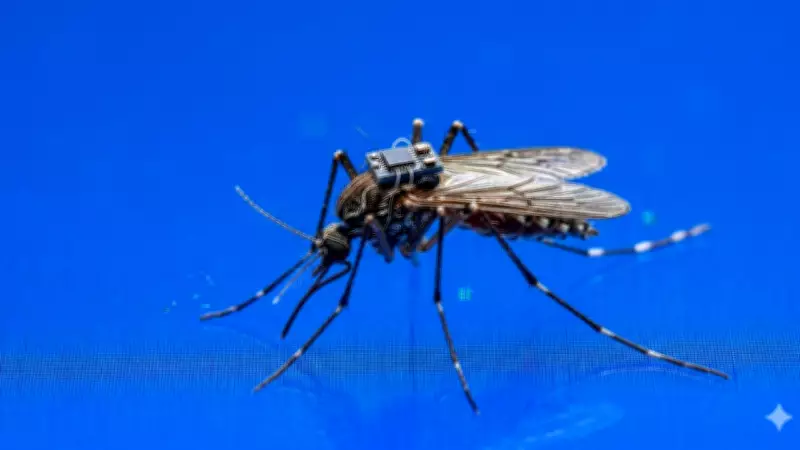
Mosquitoes are among the deadliest animals on Earth, transmitting diseases that affect hundreds of millions of people every year. Despite their enormous impact on public health, scientists have long struggled to answer a surprisingly basic question: how do mosquitoes actually move through real landscapes? Their tiny size, short flight range and unpredictable behaviour have made detailed tracking exceptionally difficult. Now, researchers have overcome that challenge using miniature harmonic radar tags capable of following individual mosquitoes as they travel through fields, grasslands and parkland environments. The breakthrough provides one of the clearest views yet of mosquito movement in the wild, offering valuable insights into how disease-carrying insects locate hosts, navigate habitats and respond to environmental features that shape their daily journeys.
How miniature harmonic radar tags allowed scientists to follow mosquitoes in the wild
Tracking insects smaller than a paperclip has historically been one of the greatest technical challenges in behavioural ecology. Traditional methods often rely on mark-release-recapture techniques, which provide limited information about an insect's actual route between two locations. To overcome these limitations, researchers from the United States Department of Agriculture - Agricultural Research Service developed ultra-lightweight harmonic radar transponders that can be attached to mosquitoes without significantly affecting their natural behaviour. The system works by transmitting a radar signal that is reflected back at a different frequency by the tag, allowing scientists to distinguish tagged insects from surrounding vegetation and environmental clutter. According to the research team, the tags weighed only a fraction of the mosquito's body mass while remaining detectable across complex outdoor environments.
The study ‘Employing tiny harmonic radar tags to study mosquito movement in natural environments’ notes: "Harmonic radar enables continuous tracking of individual mosquitoes under field conditions." By providing precise flight trajectories rather than isolated observations, the technology offers an unprecedented window into mosquito behaviour in natural landscapes.

What mosquito flight paths reveal about movement through fields and parkland habitats
The radar observations revealed that mosquito movement is strongly influenced by landscape structure. Rather than travelling randomly, many individuals followed habitat features such as vegetation edges, sheltered corridors and transitions between open and wooded areas. Researchers observed notable differences in movement patterns across agricultural fields, grasslands and parkland environments. Vegetation appeared to influence both flight direction and travel distance, potentially affecting how mosquitoes locate breeding sites, resting habitats and blood-meal hosts. The findings challenge assumptions that mosquito dispersal can be accurately predicted using simple distance measurements alone. Instead, environmental complexity appears to play a significant role in shaping movement decisions. The authors emphasised that understanding these behavioural pathways is critical because mosquito-borne diseases depend not only on insect abundance but also on how effectively mosquitoes move between hosts and habitats. The research demonstrates that even subtle landscape features can influence the routes taken by individual insects, creating movement networks that were previously invisible to scientists.

Why this breakthrough could improve mosquito control and disease prevention
The implications extend well beyond insect ecology. Mosquitoes transmit diseases including malaria, dengue, yellow fever, Zika and West Nile virus, making them one of the most significant public health threats worldwide. By revealing how mosquitoes navigate real-world environments, harmonic radar technology could help researchers design more effective control strategies. Knowing which landscape features guide movement may improve the placement of traps, targeted insecticide applications and habitat-management programmes. The approach also offers opportunities to test how environmental changes influence mosquito behaviour. Urban expansion, agricultural development and climate-driven shifts in vegetation could alter movement patterns in ways that affect disease transmission risk. Importantly, the technology provides a tool for studying mosquito ecology at an individual level rather than relying solely on population-wide estimates. That level of detail has rarely been possible before. As vector-borne diseases continue to challenge health systems globally, understanding where mosquitoes travel and why they choose particular routes could become a crucial part of future prevention efforts. Sometimes the smallest journeys can have the biggest consequences, and this new radar technology is finally allowing scientists to watch those journeys unfold in real time.