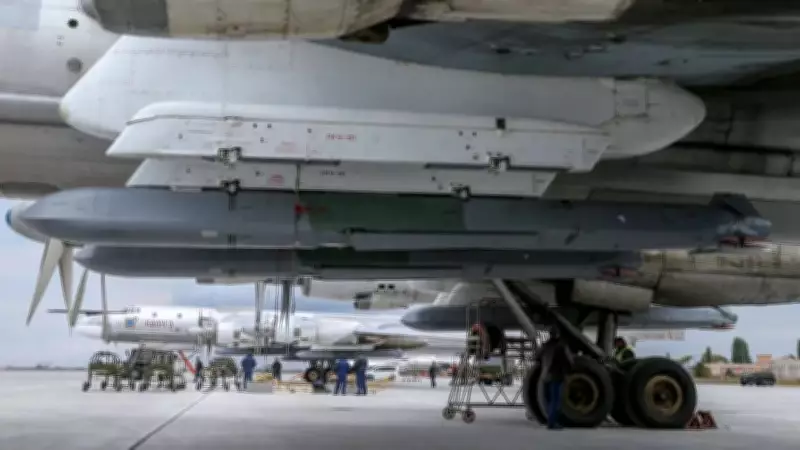
During a recent Russian attack on the Ukrainian capital, footage circulated online appearing to show a Russian-made Kh-101 air-launched cruise missile releasing decoy flares during flight. This video, similar to one released in 2023, offered rare visual confirmation of the missile's countermeasure capability, which has been widely discussed in Ukrainian and Western reports. The footage adds a visible layer to Russia's broader effort to modernize the Kh-101 family during the ongoing war, including upgrades designed to improve survivability against increasingly sophisticated Ukrainian air defense systems.
Countermeasure Details
According to The War Zone, the countermeasures in the video could reportedly be heard “popping off” as they were deployed. Unlike traditional flares, they did not appear to leave visible smoke trails. Analysts suggested these may have been spectral flares, where the primary heat plume is invisible to the naked eye, or smaller flares with shorter burn durations. Radar-confusing chaff may also have been released alongside the flares. Chaff generally consists of thin metallic strips, metalized paper, or fiberglass threads designed to interfere with radar tracking, though its deployment is often difficult to observe from the ground.
Russia's Kh-101 Upgrade Program
Ukrainian defense reporting points towards a broader wartime modernization program involving the Kh-101. According to Ukrainian outlet Defence Express, analysis of recovered missile fragments identified at least four major upgrade phases carried out during the conflict. These upgrades reportedly include a tandem warhead configuration designed to penetrate hardened targets, a cluster warhead equipped with incendiary elements, improved guidance systems, and a new electronic warfare protection suite. The electronic protection package is believed to be one of the most significant improvements, generating decoy jamming signals while deploying both thermal flares and radar-confusing chaff to mislead enemy air defense networks.

The latest footage has strengthened assessments that Russia is actively adapting its long-range strike systems to overcome Ukraine's layered air defense capabilities, which have become increasingly effective with Western military assistance.
Ukraine's Interception Claims
Despite Russia's missile upgrades, Ukrainian forces have repeatedly claimed strong interception rates against Russian aerial attacks, including cruise missiles and drones. According to Defence Express, Ukrainian air defense systems were reportedly able to intercept around 88 percent of launched Kh-101, Kh-55, and Kh-555 missiles during previous attack waves. While such figures are difficult to independently verify during wartime, analysts believe Russia's decision to equip the Kh-101 with advanced countermeasures reflects Moscow's concerns over Ukraine's improving air defense network. The War Zone noted that it could not independently confirm Ukraine's interception claims, but added that the appearance of countermeasure-equipped Kh-101 missiles suggested Russia viewed Ukrainian air defenses as a growing operational challenge.
Oreshnik Hypersonic Missile Remains Bigger Concern
Even as Ukraine demonstrates growing success against Russian cruise missile attacks, analysts say Kyiv faces a more difficult challenge in countering Russia's emerging hypersonic missile capabilities. Particular attention has focused on the Oreshnik hypersonic missile, which is capable of carrying both conventional and nuclear warheads while traveling at speeds reportedly exceeding Mach 10. Such speeds drastically reduce interception windows for air defense systems and complicate detection and tracking efforts. Military experts believe hypersonic systems like Oreshnik could become increasingly central to Russia's long-range deterrence strategy if the war continues to escalate.

What Is the Kh-101 Cruise Missile?
The Kh-101, known by its NATO reporting name AS-23 “Kodiak,” is one of Russia's most advanced strategic air-launched stealth cruise missiles. It is primarily deployed by Russian strategic bombers including the Tupolev Tu-95 and Tupolev Tu-160. Key features include an estimated operational range of 2,500 km to 3,000 km, subsonic speed of approximately Mach 0.8, GLONASS satellite navigation and inertial navigation guidance with terminal TV/imaging infrared guidance, low-altitude terrain-hugging flight paths using radar-absorbent materials, and warhead options including conventional warheads (nuclear-capable variant designated Kh-102). Recent upgrades include tandem warheads, cluster munitions, and integrated flare and chaff countermeasure systems.