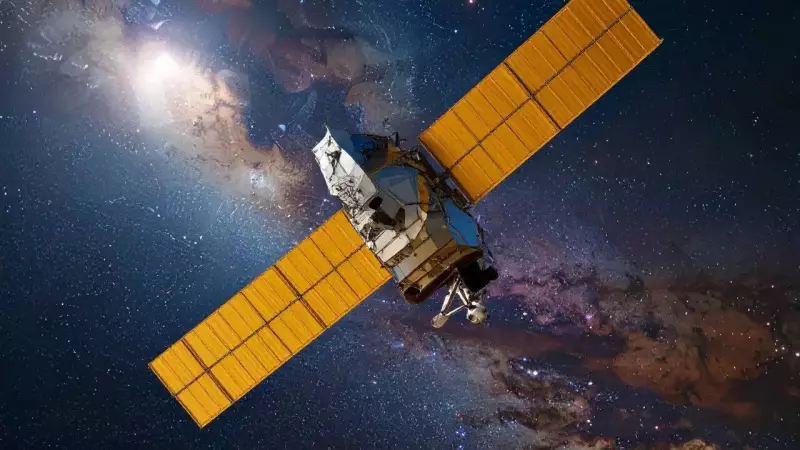
People often imagine Earth's satellites hanging motionless in the void of space. In reality, these technological marvels exist in a perpetual state of free fall. They continuously descend toward our planet, yet their tremendous forward velocity prevents them from ever reaching the ground. This delicate cosmic dance keeps thousands of satellites circling Earth every single day.
The Physics Behind Satellite Orbits
Understanding why satellites remain aloft requires grasping fundamental orbital mechanics. The secret lies in a perfect equilibrium between two powerful forces. Earth's gravity constantly tugs satellites toward its core. Without counteracting motion, any stationary object would plummet straight down.
Satellites achieve stability through incredible speed. Those in Low Earth Orbit, for instance, travel at approximately 28,000 kilometers per hour. This velocity generates outward momentum that balances gravitational attraction. The resulting trajectory curves around Earth rather than intersecting with its surface.

Newton's Cannonball Thought Experiment
Isaac Newton famously illustrated this principle centuries ago. He envisioned a cannonball fired horizontally from a mountaintop. With sufficient speed, the projectile would circle Earth indefinitely instead of striking the ground. Modern satellites operate on precisely this principle—falling continuously while moving forward fast enough to miss our planet entirely.
Weightlessness in Orbit
Astronauts aboard the International Space Station appear to float effortlessly. This phenomenon occurs not because gravity disappears, but because everything aboard falls at identical rates. Both spacecraft and occupants experience simultaneous free fall, creating the sensation of weightlessness scientists call microgravity.
Once rockets deliver satellites to proper altitude and velocity, they require no engines for sustained motion. Gravity itself bends their path into stable circular or elliptical orbits. This elegant natural mechanism allows satellites to function for years with minimal intervention.
Orbital Varieties and Their Characteristics
Engineers deploy satellites at different elevations based on specific missions. Low Earth Orbit satellites, including the International Space Station, typically operate about 400 kilometers above Earth. They complete revolutions every 90 minutes but encounter trace atmospheric particles that gradually slow them.
To counteract this drag, many satellites carry small thrusters for periodic altitude boosts. Without such adjustments, atmospheric friction would eventually pull them down to fiery destruction. Higher orbits present different advantages and challenges.
Geostationary Orbits
At precisely 35,785 kilometers altitude, satellites enter geostationary orbit. Here they match Earth's rotation, appearing stationary above fixed locations. This positioning proves invaluable for communications and weather monitoring. The extreme altitude eliminates atmospheric drag entirely, though it requires more powerful rockets to reach.
Managing Orbital Traffic
Space has grown increasingly crowded with over 13,000 active satellites now circling Earth. This congestion creates collision risks, particularly in popular orbital regions. Agencies like NASA, ISRO, and the European Space Agency constantly track objects to prevent catastrophic impacts.
The proliferation of megaconstellations like SpaceX's Starlink intensifies these concerns. Each new satellite increases potential debris from accidental collisions. Proper orbital management has become crucial for preserving space accessibility.
Maintaining functional satellites demands understanding orbital decay mechanisms. Even minimal atmospheric drag in Low Earth Orbit gradually reduces velocity. Regular corrections preserve operational orbits, while defunct satellites require controlled deorbiting to avoid becoming hazardous debris.
This complex interplay of gravity, velocity, and orbital mechanics enables everything from GPS navigation to global communications. As humanity's space presence expands, mastering these principles becomes ever more critical for scientific advancement and technological progress.