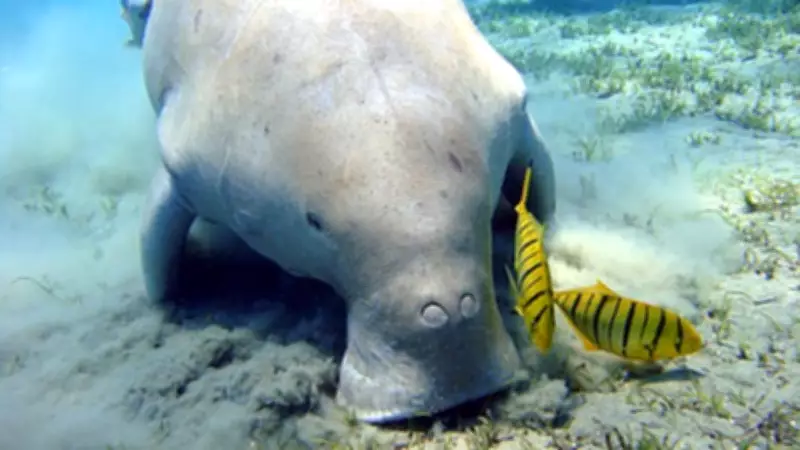
Sea cows drift quietly through tropical waters, grazing on seagrass meadows with little sign of the extraordinary evolutionary story they carry. Today, only four living species remain: three manatees and a single dugong. Yet these gentle marine mammals are the last survivors of a lineage that once spanned oceans across the globe. Fossil evidence shows that sea cows, collectively known as sirenians, have existed for roughly 50 million years, evolving from amphibious ancestors into the world's only fully aquatic herbivorous mammals. While countless relatives vanished through climatic shifts, habitat changes and human pressures, a handful endured. Their survival offers a rare glimpse into an ancient branch of mammalian evolution that predates many modern marine species and continues to shape coastal ecosystems today.
Why Sea Cows Are the World's Only Fully Aquatic Herbivorous Mammals
Among all living marine mammals, sea cows occupy a unique evolutionary position. Researchers describe sirenians as the only fully aquatic mammals that depend entirely on plant-based diets, feeding primarily on seagrasses and aquatic vegetation. Their unusual lifestyle evolved millions of years ago as their ancestors transitioned from land to shallow coastal waters.
This adaptation allowed sea cows to exploit ecological niches unavailable to whales, dolphins and seals. Their dense bones help control buoyancy while feeding along the seabed, and their slow metabolism supports a grazing lifestyle in warm coastal environments. Scientists believe these specialised adaptations helped sirenians thrive across vast regions during the Eocene, Oligocene and Miocene epochs.

The Remarkable Evolution of Sea Cows: From Ancient Amphibians to Ocean Giants
The fossil record reveals that the earliest sirenians looked very different from modern manatees and dugongs. Some of their oldest known relatives possessed four limbs and could move between land and water. Research tracing sirenian evolution notes that their fossil history extends back approximately 48 to 50 million years, making them one of the oldest surviving groups of marine mammals.
Scientists have discovered sirenian fossils on every continent except Antarctica, indicating that these animals once achieved a far broader distribution than today. During their evolutionary peak, multiple species often occupied the same coastal ecosystems, each specialising in different feeding strategies and habitats. The evolutionary success of ancient sea cows was so extensive that entire communities of dugong relatives flourished in prehistoric oceans. However, climatic cooling, changing ocean conditions and habitat loss gradually reduced their diversity over millions of years.
How Sea Cows Outlived Extinction While Most of Their Relatives Disappeared
The survival of modern sea cows is remarkable given how many sirenian species vanished. One of the most famous casualties was Steller's sea cow, a giant relative of the dugong that inhabited the Bering Sea until the eighteenth century. Steller's sea cows persisted as a relict species in the North Pacific by adapting to a highly specialised ecological niche distinct from other sirenians. The dugong family once contained far greater diversity, but today only a single living dugong species remains after the extinction of numerous relatives. Meanwhile, comprehensive evolutionary analyses show that sirenians experienced a long-term decline driven by environmental change and shrinking coastal habitats.
Despite these pressures, four species survived into the modern era: the West Indian manatee, Amazonian manatee, African manatee, and dugong. Their continued existence is closely tied to the health of seagrass ecosystems, which store carbon, stabilise coastlines and support marine biodiversity. Conservationists now regard sea cows as important indicators of coastal ecosystem health because their grazing patterns help maintain productive seagrass meadows. More than 50 million years after their ancestors first entered the water, sea cows remain living representatives of one of evolution's most unusual experiments: giant herbivorous mammals that abandoned life on land and made the oceans their permanent home.