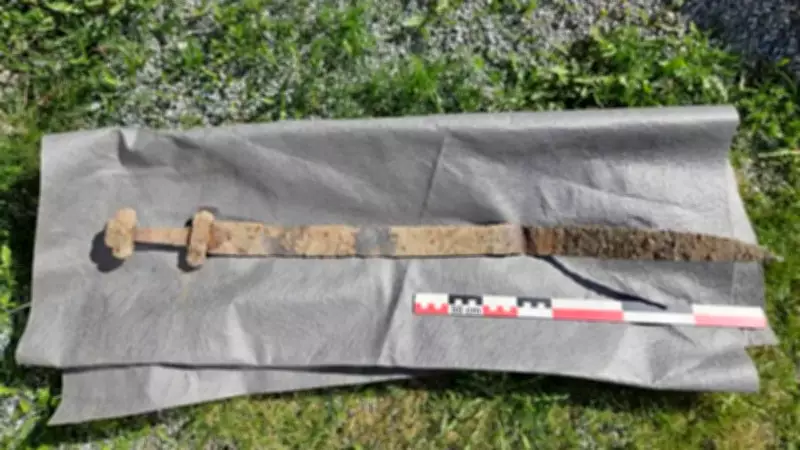
A routine school outing in Norway turned into an extraordinary archaeological event when six-year-old Henrik Refsnes Mørtvedt unearthed a 1,300-year-old sword while digging in a field in Innlandet county. The discovery occurred near Brandbu and Hadeland during a class excursion, captivating experts and the public alike.
The Accidental Discovery
Henrik, a first-grader, spotted a rusty object protruding from the plowed soil. Initially resembling scrap metal, closer inspection revealed it to be an ancient sword. Instead of attempting to excavate it themselves, Henrik's teachers promptly contacted archaeologists, a decision praised by experts. Local heritage officials stated, "We are super proud of the children who managed to see the sword in the field. Well done! And we are very happy that they did everything right: They called an archaeologist."
Historical Significance
Experts identified the sword as a rare single-edged artifact from the late Merovingian period (550–800 AD), predating the Viking Age. It is a single-handed weapon typical of Scandinavia during that era. Archaeologists believe the find is crucial for understanding early medieval Norway, its conflicts, and the emergence of the Vikings. The Hadeland region is known for Iron Age settlements, burial mounds, and Viking activity, making the discovery particularly fitting.

Preservation and Analysis
The sword has been transported to Oslo's Museum of Cultural History for conservation and study. Researchers plan to use X-rays and metallurgical analysis to determine how it was forged, its usage, and the identity of its original owner, likely a warrior or high-status individual. Although heavily corroded, the artifact resembles Type F Viking swords cataloged in Norwegian archaeological studies for over a century.
Broader Context of Viking Discoveries
Norway and neighboring Scandinavia have yielded numerous Viking-era relics, often found by reindeer hunters, hikers, and children due to the region's cold climate. In 2018, an eight-year-old Swedish girl discovered a pre-Viking sword while playing near a lake during a drought. Similarly, ten-year-old Fionntan Hughes unearthed a Viking sword using a birthday metal detector. Such accidental finds by children generate public excitement and remind archaeologists of hidden treasures beneath Europe's soil.
Future Implications
As conservation work progresses in Oslo, historians hope the sword will provide insights into Viking operations before their expansion across Europe. The discovery underscores the importance of preserving archaeological sites and the potential for unexpected finds to reshape historical understanding.