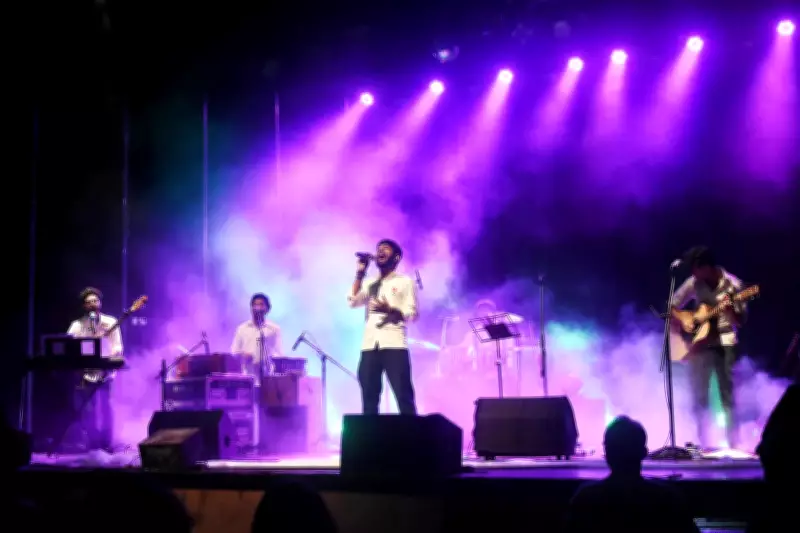
Kolkata witnessed an evening where music transcended mere entertainment as STB Collective's SongGothon 3 turned Uttam Mancha into a powerful arena for reflection, protest, and performance. At a time when mainstream concerts increasingly prioritize spectacle and commercial appeal, the independent Bengali music ensemble delivered a production that fused original music with theatre, satire, choreography, and spoken narrative to create an immersive socio-political experience.
A Layered Exploration of Contemporary Realities
Performed before a packed auditorium on Sunday evening, the 2.5-hour showcase unfolded as a multifaceted exploration of modern life — from environmental destruction and economic disparity to urban alienation and emotional anxieties. Through poetic songwriting, dramatic stagecraft, and visual storytelling, the performance pushed Bengali independent music beyond conventional concert formats and reclaimed it as a medium for dialogue and social engagement.
Musical and Theatrical Highlights
Presented by Shudhu Tomakei Bhalobese (STB) Collective, the event highlighted the evolution of Bengal's alternative music scene, where younger artists increasingly use music as a form of cultural and political expression. Original compositions by Nilanjan Ghosal, Sudhaborshy Chakraborty, Ritaban Guha, and Pritam Das formed the emotional core of the evening, while performances by Bidisha Das, Sinjay Chakraborty, Arghya Bhattacharya, Ritwick Maity, and Swapnaneel Bose added varied musical textures. Choreography by Srijita Mukherjee and Souparna Dey further expanded the theatrical language of the show.

Balancing Activism with Intimacy
What distinguished SongGothon 3 was its ability to balance activism with intimacy. Alongside sharp social commentary, the concert retained a youthful emotional pulse through contemporary Bengali soundscapes and romance-infused compositions, allowing audiences to connect both politically and personally. One of the evening's most striking moments reflected on humanity's fractured relationship with nature, using evocative lyrical imagery to question whether society could truly grieve for what it continued to destroy.
Vision Behind the Initiative
Speaking about the vision, lyricist and musician Nilanjan Ghosal said, "SongGothon is deeply personal to us because it allows us to create an honest connection with the audience. It is not just a music show but a complete experience where we express ourselves without filters." The audience response underlined a growing appetite for meaningful independent art in Bengal. Dr. Anupam Das, who has attended all three editions, said the collective had created "a completely different musical language where performances feel socially aware, emotionally alive, and authentic."
With SongGothon 3, STB Collective reinforced the idea that contemporary Bengali music can remain political, poetic, and deeply rooted in public consciousness — proving that art continues to hold the power to question, provoke, and resonate long after the stage lights fade.