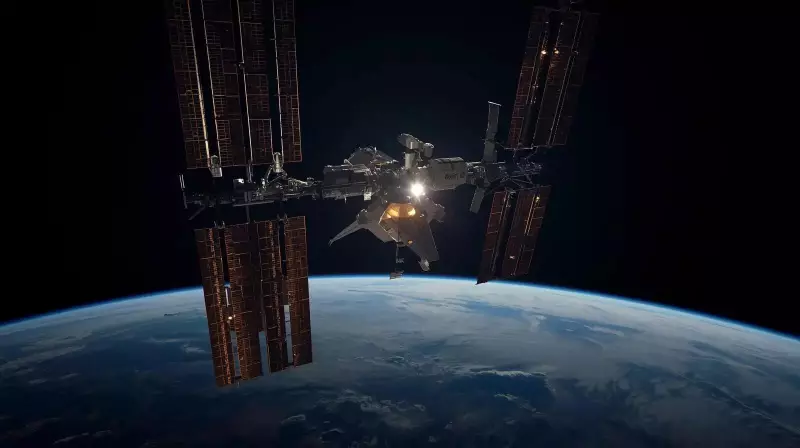
In a meticulously executed maneuver that underscores the seamless collaboration between space agencies and commercial partners, the International Space Station received another subtle orbital adjustment late last week. This routine yet vital procedure ensures the orbiting laboratory maintains its optimal altitude above Earth, preserving its scientific capabilities and safety for the crew onboard.
Precision Engine Burn Elevates Station's Orbit
On Friday, January 23, a SpaceX Dragon spacecraft currently docked with the ISS initiated a controlled engine burn lasting just over 26 minutes. The gentle thrust from the spacecraft's Draco engines gradually raised the station's orbit, demonstrating the precision engineering required for such operations. This maneuver was conducted as part of standard station maintenance rather than in response to any immediate threat or emergency situation.
The reboost specifically targeted the station's orbital parameters, resulting in a modest but measurable elevation. The ISS now follows an elliptical path ranging between approximately 269 miles at its highest point and 255 miles at its lowest point above Earth's surface. From inside the station, astronauts likely noticed little more than routine vibrations, but from mission control perspectives on the ground, this adjustment carried significant importance for long-term operations.

Counteracting Atmospheric Drag Through Regular Adjustments
Orbital reboosts serve a critical function in compensating for the subtle but persistent drag exerted by Earth's upper atmosphere. Even at altitudes exceeding 250 miles, trace atmospheric particles gradually slow the station, causing it to descend over time. Without these periodic corrections, the ISS would eventually re-enter Earth's atmosphere prematurely.
SpaceX's Dragon spacecraft has become an integral component of this maintenance regimen, with this particular vehicle flying the company's 33rd commercial resupply mission for NASA. Having arrived at the station in late August, this Dragon capsule has remained docked longer than typical missions, quietly performing its duties while awaiting return to Earth.
Dragon's Engine System: Designed for Delicate Operations
The recent reboost utilized two Draco engines located in the Dragon spacecraft's trunk section. These thrusters operate on their own propellant supply, separate from the main vehicle systems, allowing for precise orbital adjustments without affecting the spacecraft's primary functions.
Dragon carries a total of 16 Draco thrusters, each generating approximately 90 pounds of thrust in vacuum conditions. While individually modest in power, these engines collectively enable the delicate maneuvers required for station operations, including:
- Fine orbital adjustments and reboosts
- Orientation control and stabilization
- The intricate choreography of docking and departure procedures
The spacecraft also features eight more powerful SuperDraco engines designed for launch abort scenarios rather than routine station operations. Their presence contributes to the overall safety profile that makes Dragon a trusted vehicle for NASA missions.
A Series of Autumn and Winter Reboosts
This January maneuver represents the final planned reboost for this particular Dragon mission. The spacecraft has conducted multiple orbital adjustments throughout its extended stay, with previous burns occurring in:
- Early September
- Late September
- October
- November
- December
This systematic approach to station maintenance reflects the careful planning that enables continuous human presence in space. Soon, the Dragon spacecraft will undock from the ISS and return to Earth, carrying valuable research samples and equipment before splashing down in waters off the California coast.
Scientific Implications of Orbital Stability
Maintaining precise orbital parameters extends beyond mere station preservation. The ISS's altitude directly influences the quality and consistency of scientific research conducted onboard. Numerous experiments depend on stable microgravity conditions that can be compromised by even minor orbital fluctuations.
Specific research areas benefiting from orbital stability include:

- Crystal growth studies that require undisturbed conditions
- Fluid dynamics experiments monitoring motion in microgravity
- Long-term Earth observation and environmental monitoring
- Auroral activity studies that benefit from clearer viewing angles at slightly higher altitudes
Researchers particularly value stable orbits during periods of increased solar activity, when auroral phenomena become more pronounced and scientifically interesting.
The ISS's Continuing Legacy and Future
The International Space Station continues its remarkable journey, orbiting Earth at approximately 17,500 miles per hour and completing a revolution every 90 to 93 minutes. For more than 25 years, the station has maintained continuous human occupation—a testament to international cooperation and engineering excellence.
With plans established for a controlled deorbiting around 2030, each routine reboost takes on added significance. These minor corrections, executed without fanfare, extend the station's operational lifespan incrementally, allowing for additional scientific discovery and technological advancement.
The collaboration between NASA and commercial partners like SpaceX exemplifies how public-private partnerships can sustain complex space operations. As the ISS approaches its eventual retirement, these routine maneuvers ensure maximum return on the substantial international investment in orbital research infrastructure.