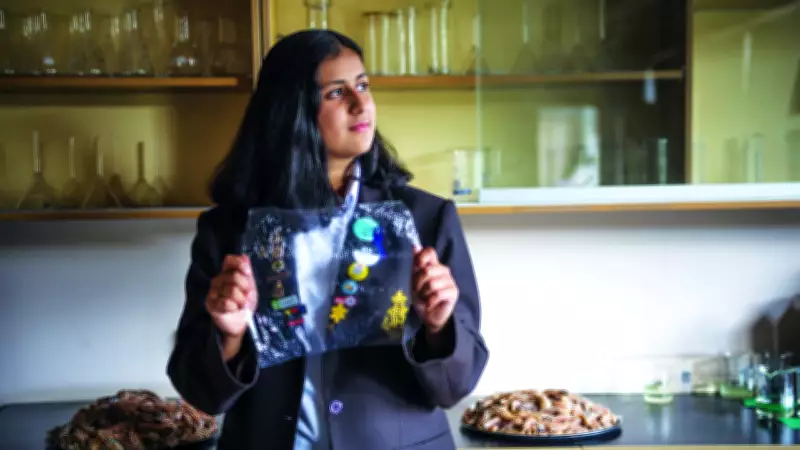
A stack of prawn shell waste is usually considered kitchen waste by many people. However, Angelina Arora had a different idea in mind. As people all over the world try to look for ways to minimise dependence on plastic products, this Australian teen started questioning whether there would be any way to use seafood waste to make a valuable product.
Her quest took her through months of experimentation until she successfully managed to develop a type of bioplastic made out of prawn shells and silk proteins. An idea that started as a school science fair project quickly attracted recognition from experts and earned her several awards. Most importantly, it showed a new perspective on how garbage could be used in solving some of the largest problems facing the planet today. While other children her age prepared for their final exams, Angelina came up with an alternative to plastics.
How Angelina Arora transformed discarded prawn shells into biodegradable plastic
The idea emerged from a simple observation. Concerned by the environmental impact of single-use plastics, Angelina began exploring biodegradable alternatives as part of a school science project.

After experimenting with materials such as cornstarch and banana peels, she noticed a striking similarity between prawn shells and conventional plastic. "I looked at prawns and thought, what makes their shells look like plastic? Maybe I can take that out and use it in some way and bind it to make a plastic-like material," Angelina explained in an interview with National Geographic.
The subject of her studies was chitin, a natural polysaccharide that can be found in the hard outer shell of many animals, such as crustaceans and insects. Chitin is the second most common natural polymer on the planet after cellulose and has gained considerable attention for its potential use in biodegradable materials.
With the help of mentors and experts, Angelina isolated the chitin from waste prawn shells and used chemicals to convert the substance into chitosan, which she mixed with fibroin. "The dream is to basically have every single plastic in the world made out of my plastic," she said while discussing the project's long-term vision.
The resulting material demonstrated many of the characteristics required for practical packaging applications: flexibility, strength, transparency and durability.
Why this prawn-shell plastic could help tackle the global plastic pollution crisis
One of the most remarkable features of Angelina's invention is its rate of decomposition. According to her research, the bioplastic breaks down completely within approximately 33 days under landfill conditions, vastly outperforming conventional petroleum-based plastics that can persist in the environment for centuries. National Geographic reported that the material decomposed around 1.5 million times faster than standard commercial plastics.
The innovation also addresses another environmental challenge: seafood waste. Every year, large quantities of prawn, crab and lobster shells are discarded by seafood processors and retailers. By transforming this waste stream into a useful material, the technology supports principles of the circular economy.
An additional benefit lies in the chemical composition of crustacean shells. Because they contain significant amounts of nitrogen, the material can return nutrients to the environment as it breaks down.
Industry observers and manufacturers have shown interest in the technology because the material is flexible, insoluble, transparent and suitable for packaging applications. Angelina has also explored its potential use in medical packaging.
The award-winning school project that challenged science stereotypes
What began as a classroom project quickly gained national and international attention. According to the official press release by the Commonwealth Scientific and Industrial Research Organisation, Angelina's work earned the Innovator to Market Award at the 2018 BHP Billiton Foundation Science and Engineering Awards, one of Australia's most prestigious competitions for young researchers.
Her project later represented Australia at the Intel International Science and Engineering Fair, where she competed against students from more than 75 countries and secured fourth place globally.

Beyond the scientific achievement itself, Angelina has consistently spoken about encouraging more young people, particularly girls, to pursue careers in science, technology, engineering and mathematics. "Everyone should do whatever they can, so I'm just trying to play my part." Reflecting on the motivation behind her work, she added: "Every time I fail or things don't work out in the lab, I always think back to why I started doing it. That is to make oceans plastic-free and encourage other young people, especially young girls, to make a difference in the world."
Her success stands as a reminder that scientific breakthroughs do not always emerge from large laboratories or multinational corporations. Sometimes they begin with curiosity, persistence and a willingness to look at everyday waste in a completely different way.