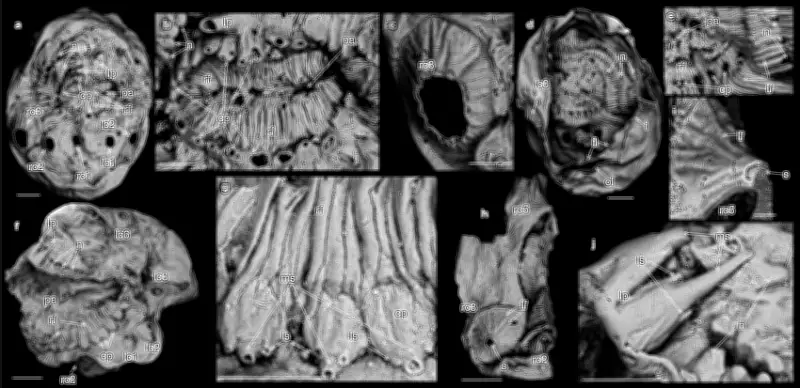
There was once an extraordinary little animal that fascinated the scientific world when it was discovered as a potential origin point for human evolution from rock formations in China. This tiny, spherical organism, named Saccorhytus coronarius, dates back to the early Cambrian period, approximately 535 million years ago. Measuring only one millimeter in length, it initially appeared to be an example of the origins of humans themselves.
Peering beyond the compressed appearance of the fossil, researchers uncovered anatomical features that contradicted earlier interpretations. This finding suggested that the small marine creature should be excluded from being a direct ancestor to humans, leading to a broader reconsideration of how certain animal fossils are analyzed. It highlighted the general difficulties of making sweeping claims about prehistoric creatures based on fossils that have undergone immense pressures over millions of years.
Revealing the True Anatomy Beneath the Surface
The initial excitement surrounding the specimen stemmed from the belief that it might represent a primitive member of the deuterostome group. This overarching evolutionary branch contains everything from starfish to humans. According to a Nature study titled "Saccorhytus is an early ecdysozoan and not the earliest deuterostome," earlier interpretations appear to have misread the superficial holes surrounding the creature's massive mouth. What had previously been identified as primitive gill slits, a classic diagnostic feature of early vertebrate relatives, were interpreted by the new study as something entirely different.

To resolve the controversy, an international team of researchers utilized a particle accelerator to generate high-intensity X-rays, capturing hundreds of highly detailed structural angles to reconstruct the organism in three dimensions. As the detailed analysis in Nature indicated, the digital reconstruction suggested that these supposed respiratory holes were likely the broken bases of sharp, protective spines that had snapped off during the fossilization process. Without confirmed gill structures, the core argument for placing the animal on our own evolutionary path was significantly weakened, prompting scientists to look for an alternative classification.
Relocating a Bizarre Creature on the Tree of Life
The correction of the anatomical blueprint did not strip the microscopic organism of its historical significance. Instead, it helped clarify a long-standing mystery regarding the rapid diversification of marine life during the Cambrian explosion. By tracing the revised arrangement of the spines, researchers proposed realigning the creature with a different major animal group of ancient biodiversity. As documented in a study on the early evolution of the ecdysozoan body plan, Saccorhytus potentially belonged to the primitive lineage of ecdysozoans, a highly successful group of moulting animals that includes modern insects, spiders, and roundworms. Rather than being a distant grandparent to humanity, the spiny, sack-like animal appears to have been an early pioneer of an entirely separate biological dynasty.
In fact, nowadays, the reassessment of Saccorhytus has been viewed as a notable case of scientific self-correction, illustrating how advancements allow humanity to gain further insight into its distant geological past. It shows us that theories about evolution benefit from being backed by physical evidence rather than assumptions. It suggests that our origins are rooted in an age when there were numerous experiments with different body plans, and that research often depends on the minutest details of those times. One might say that although popular science media tends to look for simple paths from primordial times to Homo sapiens, in reality, the fossil record often resembles an incredibly tangled forest, and even one small creature with its prominent mouth can present interpretive challenges for decades.