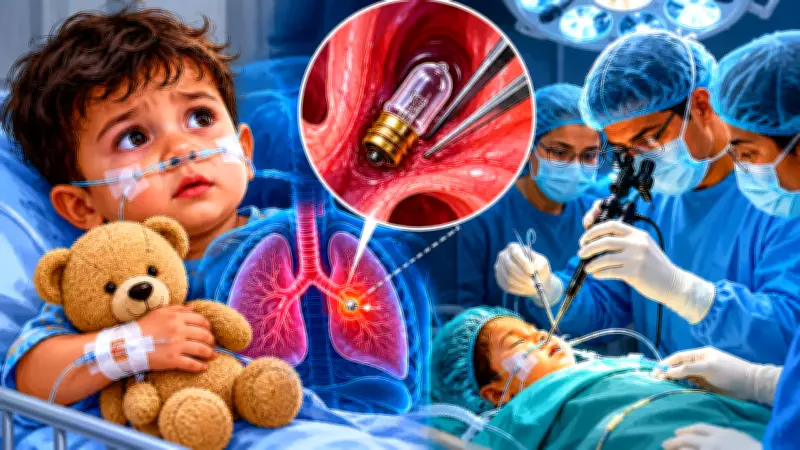
A stubborn cough in a two-year-old child turned into a critical airway emergency requiring highly coordinated medical intervention. The child was taken to the hospital's Emergency Department on May 11 with persistent cough, noisy breathing, difficulty breathing, and intermittent fever. Doctors said the symptoms had lasted for nearly a week. Initially, the family had seen a local pediatrician as the cough would not settle.
During the assessment, the parents recalled an occasion when a small bulb-like part of a television remote control may have been choked on. The pediatrician suspected that the child had aspirated a foreign body, meaning an object had gone into the airway instead of the food pipe, and immediately referred the child to Amrita Hospital for urgent management.
Investigations showed that the object had gone deep into the right lower bronchus, a small air passage inside the lung. The doctors noted that the case was particularly risky because the foreign body had metallic wire elements and a fragile glass component. The prolonged stay in the airway had also provoked granulation tissue formation, which made removal more difficult.

Several specialty teams quickly collaborated to organize an urgent bronchoscopy in the operating room, aware of the risks of injury, bleeding, and total airway obstruction. The procedure involved a multidisciplinary team of experts from Amrita Hospital, Faridabad, including Pediatric Pulmonology, Adult Pulmonology, Pediatric Anesthesia, and ENT services. Key specialists involved were Dr. Maninder Dhaliwal, Dr. Sourabh Pahuja, and Dr. Ridhima Bhatia.
Advanced bronchoscopy techniques were used by doctors to gently remove the foreign body without further trauma to the airway. The child experienced instant relief when the obstruction was cleared and recovered sufficiently to be discharged within a day.
Doctors emphasized that such cases can become life-threatening very quickly if symptoms are ignored or delayed. Frequent coughing, loud breathing, or sudden difficulty breathing after a choking episode should always be taken as warning signs, particularly in children.
“This case was a reminder that in pediatric airway emergencies, timing and teamwork can be the difference between crisis and recovery,” said the treating team.