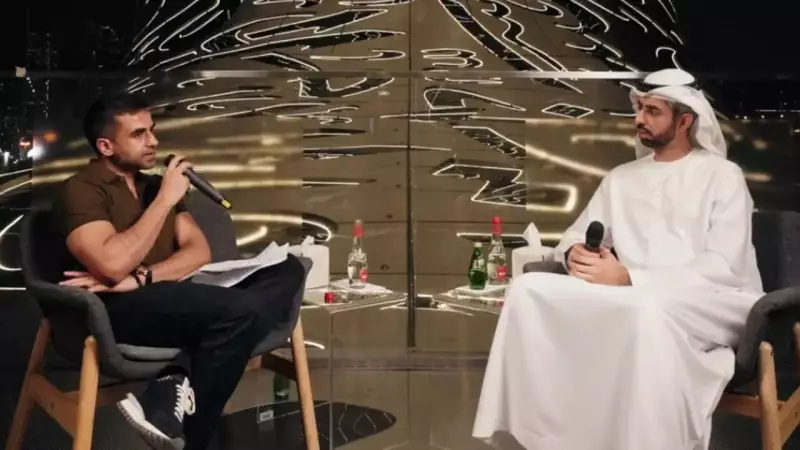
Omar Sultan Al Olama, the United Arab Emirates Minister of State for Artificial Intelligence and Digital Economy, has delivered a crucial warning about human survival in the age of artificial intelligence. During a podcast interview with entrepreneur Nikhil Kamath, the minister expressed clear concerns about the future of work and human relevance.
Hyper-Specialization Creates Vulnerability
Minister Al Olama stated directly that humans risk becoming endangered if they concentrate solely on excelling in one narrow field. He explained that artificial intelligence systems now outperform humans in specific tasks, whether those tasks involve repetition or complex analysis. This technological advancement makes specialized human skills increasingly vulnerable to replacement.
"AI is going to beat us to the target," Al Olama emphasized. "If you have to be hyper-specialized, AI can do that better than us." His comments reflect the changing reality of global job markets, where technological progress threatens to make many specialized positions redundant.

The Solution: Developing Broad Intelligence
The minister urged people to cultivate wide-ranging knowledge rather than deep but narrow expertise. He argued that breadth of knowledge provides the only real chance for humans to remain relevant alongside artificial intelligence. This approach involves connecting information across different disciplines and developing versatile thinking abilities.
Broad intelligence encompasses several crucial human capabilities that AI currently struggles to replicate fully. These include critical thinking across various contexts, creative problem-solving, and the ability to synthesize information from multiple fields. Humans who develop these skills can complement AI systems rather than compete directly with them.
Reinterpreting the "Jack of All Trades"
Al Olama offered a fresh perspective on the familiar saying about being a jack of all trades. While many people know the first part - "a jack of all trades is a master of none" - the minister highlighted the complete version: "But most times better than a master of one."
In an AI-dominated world, this complete saying takes on new significance. Individuals with diverse skills across multiple areas demonstrate greater adaptability and resilience. They can navigate changing circumstances more effectively than those with deep but limited expertise in single domains.
Keeping Technology in Its Proper Place
The UAE minister addressed broader societal concerns about technology's role in human life. He stressed that artificial intelligence should always serve humanity rather than dominate it. "AI has to always be the second priority," Al Olama declared, emphasizing that technological innovation must not compromise fundamental human needs.
This perspective aligns with growing international discussions about responsible technology governance. Policymakers, business leaders, and citizens worldwide increasingly question how to balance rapid technological advancement with ethical considerations, social welfare, and economic fairness.
Transforming Education for the AI Era
Minister Al Olama's warnings carry significant implications for education systems and career development. Traditional educational approaches often emphasize deep specialization in particular subjects or professions. While this method produces experts in specific fields, it may leave graduates unprepared for a world where computers handle routine and technical operations.
The minister's comments highlight the growing importance of interdisciplinary learning approaches. Educational institutions must prioritize developing creativity alongside critical thinking skills. Students need exposure to multiple knowledge domains to build the flexible intelligence required in AI-augmented workplaces.
This educational shift represents more than just curriculum changes. It requires rethinking how we prepare people for careers that will increasingly involve collaboration with artificial intelligence systems. The goal becomes developing human capabilities that machines cannot easily replicate.

As artificial intelligence continues advancing, Minister Al Olama's message serves as both warning and guidance. Humans must embrace versatility and broad knowledge to thrive alongside intelligent machines. The future belongs not to narrow specialists but to adaptable generalists who can navigate complex, AI-enhanced environments.