

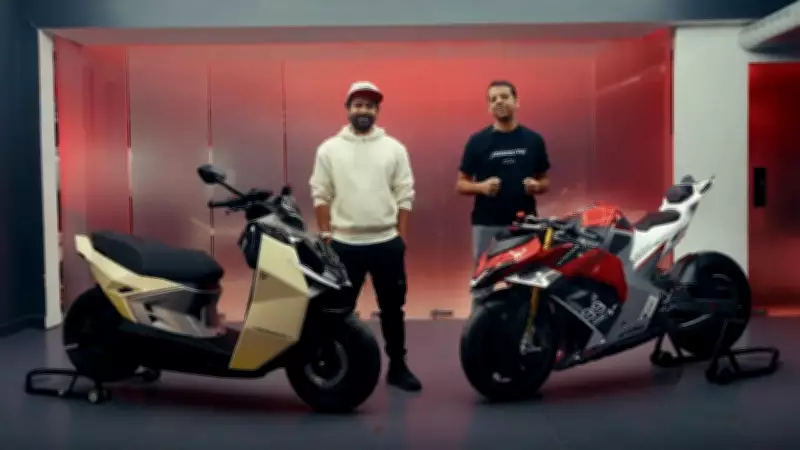
Ultraviolette Automotive, the Bengaluru-based electric vehicle manufacturer, has announced a significant delay in the launch of its highly anticipated Tesseract electric scooter. Originally expected to debut earlier, the company now targets January 2027 for the official launch, with deliveries and on-road presence commencing in the first quarter of 2027. This decision stems from a fundamental engineering pivot: transitioning the Tesseract to what the company claims is India's first 100V scooter architecture.
The Engineering Challenge Behind the Delay
Founders Narayan Subramaniam and Niraj Rajmohan explained that the delay was not driven by cosmetic changes or software tweaks but by the physics of power delivery. The initial goal was to create a scooter with performance equivalent to a 200-250cc internal combustion engine machine, delivering 15 kW of peak power from a 4 kWh battery pack. However, existing scooter architectures, which typically operate at 50-60 volts, became a bottleneck.
“Scooters today operate at up to 50-60 volts. We realised that to consistently deliver 15 kW without compromising thermals, efficiency or packaging, we had to fundamentally redesign the architecture,” said Rajmohan. Pushing higher power through a low-voltage system increases current flow, leading to exponential heat losses. This forced Ultraviolette to redesign critical subsystems, including the battery pack, motor controller, thermal management systems, and power electronics.

Learning from High-Performance Motorcycles
The move to a 100V setup allows Ultraviolette to reduce current while maintaining higher power output, resulting in lower thermal losses, sustained performance, and faster charging. Interestingly, the learnings for this architecture came from the company's high-performance motorcycle projects, such as the F77 and the extreme F99 racing platform. Rajmohan demonstrated this by comparing motor controllers: a previous-generation controller weighing nearly six kilograms handled around 50 kW, while the new compact controller for the Tesseract is smaller and lighter yet enables significantly higher power density. According to the company, similar-sized controllers in mainstream scooters currently handle roughly 3-5 kW, whereas Ultraviolette claims to have extracted 15 kW from its new system.
Market Position and Expansion
The Tesseract is expected to become Ultraviolette's first true mass-market product, with over 70,000 bookings already registered. To prepare for volume production, the company is expanding its manufacturing footprint. Its current facility can support up to 5,000 vehicles per month, while a larger future plant is under discussion. Ultraviolette has also signed a Memorandum of Understanding with the Telangana government for future expansion.
Ultraviolette has already delivered over 3,000 units of its X47 motorcycle, with volumes growing four times faster than the F77's initial ramp-up phase. The company is witnessing not only traditional ICE-to-EV migration but also EV-to-EV switching, where customers move from electric scooters to higher-performance electric motorcycles. International interest has also grown, with many overseas distributors discovering Ultraviolette through its European presence at events like EICMA.
Consumer Feedback and Features
The Tesseract has evolved significantly since its first showcase last year. Ultraviolette conducted public showcases across 30 cities, gathering direct consumer feedback that led to subtle changes, including a larger seat, slimmer floorboard, improved accessibility, and revised ergonomics. The scooter will feature 14-inch wheels, relatively long-travel suspension, dual-channel ABS, traction control, and radar-based safety systems—technologies still rare in India's e-scooter segment.
Currently, the Tesseract is undergoing an extensive four-month advanced road testing and validation phase ahead of production. The company remains confident that the delay will result in a superior product capable of meeting global compliance standards and consumer expectations.






