

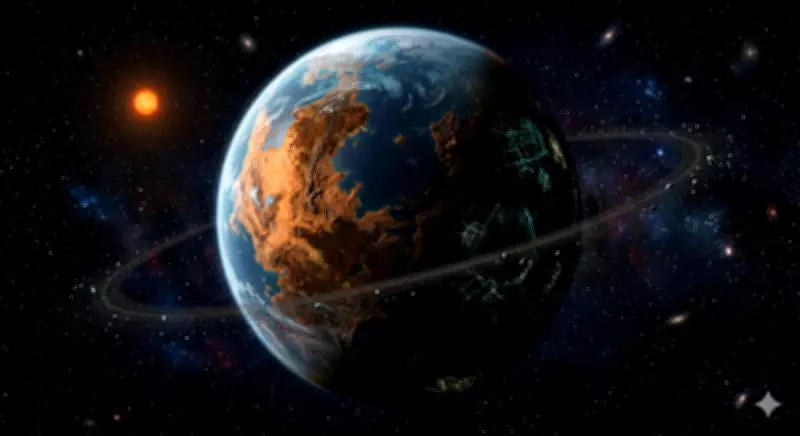
Water: The Unsung Hero of Planetary Climate Regulation
While water is universally acknowledged as the fundamental building block of life, groundbreaking astronomical research now positions it as an equally critical component for maintaining a planet's long-term climate stability. The study of distant exoplanets reveals a profound truth: without adequate water reserves, a world cannot establish a stable carbon cycle, which is the planetary mechanism responsible for regulating atmospheric carbon dioxide levels.
The Carbonate-Silicate Cycle: Earth's Natural Thermostat
On our own planet, this process is known as the "carbonate-silicate cycle," functioning as a global thermostat that has maintained Earth's climate within habitable ranges for billions of years. This intricate system relies on continuous interaction between a planet's atmosphere, surface geology, and interior dynamics.
Here's how this remarkable process unfolds:

- Precipitation absorbs atmospheric carbon dioxide, forming weak carbonic acid
- This acidic rainfall weathers surface rocks, gradually breaking them down
- Carbon becomes embedded within newly formed minerals
- Tectonic movements transport these carbon-rich minerals into the planetary interior
- Volcanic activity eventually releases carbon dioxide back into the atmosphere
New Research Challenges Traditional Habitability Models
The recent paper 'Carbon cycling and habitability of massive Earth-like exoplanets' provides compelling evidence that limited surface water dramatically reduces silicate weathering rates. This weakening of the geological feedback mechanism directly compromises a planet's ability to maintain climate stability over astronomical timescales.
The researchers emphasize that without sufficient water, this critical carbon cycling process becomes severely impaired or ceases entirely, potentially transforming a world into either a frozen wasteland or an overheated inferno. This revelation carries profound implications for how scientists identify potentially habitable worlds.
As the study authors note, "Habitat zones for rocky planets should take into account active geochemical cycles, rather than just distance from their star." This represents a significant paradigm shift in exoplanet research, suggesting that many planets within traditional habitable zones might be fundamentally uninhabitable due to water deficiencies.
Redefining the Search for Extraterrestrial Life
These findings fundamentally alter the criteria for identifying potentially life-supporting exoplanets. For decades, astronomers have primarily focused on locating planets within the "Goldilocks zone"—the orbital region around a star where temperatures might allow liquid water to exist on a planetary surface.
However, this new research demonstrates that merely occupying this favorable orbital position is insufficient. Exoplanets must also possess adequate water resources to power the geological cycles that stabilize their atmospheres over geological timescales.
NASA scientists have long recognized that "long-term climate stability depends on balancing carbon inputs and outputs." Water emerges as the essential ingredient that maintains this delicate equilibrium. Without it, planets experience extreme climate fluctuations that would make sustained biological evolution nearly impossible.
The Future of Exoplanet Exploration
Astronomers are now developing more sophisticated criteria for evaluating exoplanet habitability. Future space missions will increasingly focus on detecting atmospheric compositions and geological characteristics that could support stable carbon cycling.
Advanced telescopes and observational techniques will search for chemical signatures indicating active water cycles and geological processes on distant worlds. This represents a significant advancement beyond simply identifying planets within habitable zones.
Water as the Ultimate Habitability Marker
Water is proving essential not merely as a potential medium for biological processes, but as the fundamental driver of planetary climate regulation. Worlds that appear otherwise promising might prove permanently uninhabitable if they lack the hydrological resources to sustain carbon cycling processes.

As research continues, scientists are developing increasingly nuanced criteria for defining planetary habitability. These new models move beyond simplistic water availability assessments to consider complex chemical, geological, and climatic interactions.
This evolving understanding opens exciting possibilities for addressing one of humanity's most profound questions: Are we alone in the universe? By refining our search parameters to include water's role in climate stabilization, we increase our chances of identifying truly Earth-like worlds capable of supporting life over geological timescales.





