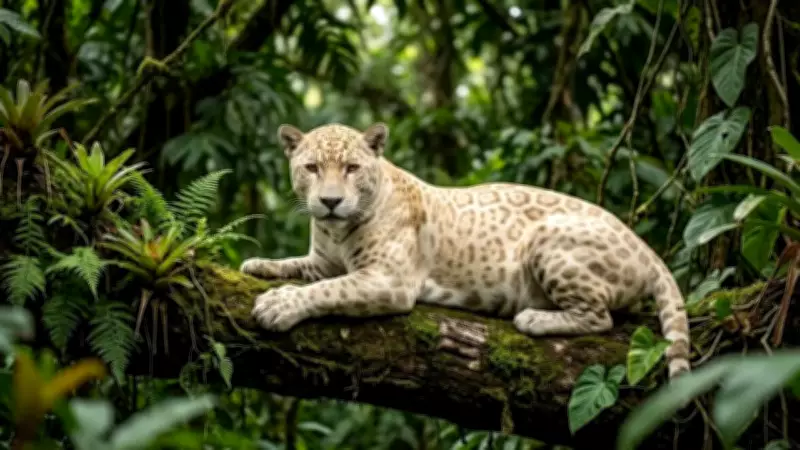
Many people commonly refer to pale, leopard-like animals as white panthers. In reality, the white panther is not a distinct species. White panther is a general term attributed to big cats, usually a jaguar or leopard, that possesses a genetic mutation such as albinism or leucism. These conditions suppress natural pigments, giving them a ghostly white or cream-colored appearance. Essentially, they are the same species as their tawny or spotted relatives, just wearing a different coat due to a one-in-a-million genetic fluke.
White Panther: Why It Is a Leopard, Not a New Species
When people talk about a white panther, they are often using a term that does not fit the scientific reality. In wildlife biology, there is no distinct animal species called a white panther. According to the International Fund for Animal Welfare (IFAW), the word panther simply refers to a larger group of big cats, members of the Panthera genus, which includes leopards, jaguars, and lions. So, when you see an individual big cat with an unexpectedly white coat, it is just a rare color variation of an existing species, most often an Indian leopard or a jaguar. These stunning animals carry the same genetic blueprint, their bones are structured identically, and they hunt just like their relatives with spots or tawny fur. They are born to parents who look perfectly normal but who happen to carry a particular recessive gene. Referring to them as a white panther is like suggesting someone with blonde hair is a different species of human; it is merely a difference in outward appearance, not a fundamental change in biology.
The Origins and Global Footprints of the White Panther
The term white panther is a historical misnomer derived from the ancient Greek word panthēr, used to describe any large, spotted cat. Over time, it became a catch-all label for leopards and jaguars born with rare white coats. These animals are globally distributed but incredibly scarce; they have been documented in the dense rainforests of South America (jaguars), the scrub forests of India (leopards), and historical records even point to sightings in China and Southeast Asia.

What Causes the Ghostly White Appearance of These Big Cats
As noted in a study on the National Institutes of Health, the striking, almost ghostly white look of these cats comes down to two different genetic conditions: albinism and leucism. Albinism happens because of a complete absence of melanin, the pigment responsible for color, usually due to a mutation affecting the tyrosinase enzyme. You can usually tell an albino cat by its distinctive lack of ocular pigment and a pink nose, since the blood vessels beneath the unpigmented tissue are visible. Leucism, on the other hand, means there is only a partial loss of pigmentation, caused by a flaw in how neural crest cells migrate during skin development. Unlike albinos, cats with leucism typically keep their natural eye color, which might be a brilliant blue or a warm gold, and sometimes they even show faint ghost rosettes, pale spots that only become noticeable under certain lighting. Both of these conditions are recessive, meaning that for a white cub to be born, both parents must carry the specific gene, making such a sight a truly rare statistical happenstance in nature.

Why Does Nature Reject White Panthers?
Humans might find the sight of a white panther absolutely breathtaking, but for nature, this kind of beauty can often be a fatal flaw. For a predator that relies on stealth, camouflage is a crucial tool for survival. A leopard's typical golden coat with its dark rosettes creates disruptive coloration, allowing it to effectively disappear into the broken light and shadow of the forest floor. A white coat, however, does the opposite; it serves as a highly visible beacon, giving away the cat's presence to prey like deer and monkeys long before it can get close enough to strike. This often leads to repeated failures in hunting and, eventually, starvation. Beyond the challenges of finding food, these cats also face serious health risks; without melanin, they are far more vulnerable to skin cancers and the sun's harsh radiation. Moreover, albinism can often be linked to poor depth perception and nystagmus, which is an involuntary movement of the eyes; these are catastrophic disadvantages for an animal that needs high-speed precision to catch its next meal. In the unforgiving wild, being one-in-a-million can sadly often mean a death sentence.