Despite repeated awareness drives by law enforcement, cybercriminals continue to prey on citizens in Bhopal with alarming success. In a shocking revelation, police registered four separate cases of online fraud on a single day—January 8—with victims collectively losing lakhs of rupees. The incidents, reported from areas like MP Nagar, Kolar Bairagarh, and Piplani, highlight the evolving tactics of fraudsters and the vulnerability of even tech-savvy individuals.
One Day, Four Victims: A Spectrum of Scams
The cases registered on January 8 paint a grim picture of the cyber threat landscape in the city. The victims include a 33-year-old Reserve Bank of India (RBI) employee, a 72-year-old retired government staffer, a 19-year-old college student, and a 27-year-old woman working a private job. The methods employed ranged from malicious links and fake digital arrests to fraudulent job offers and investment schemes.
RBI Employee Falls for E-Challan Link
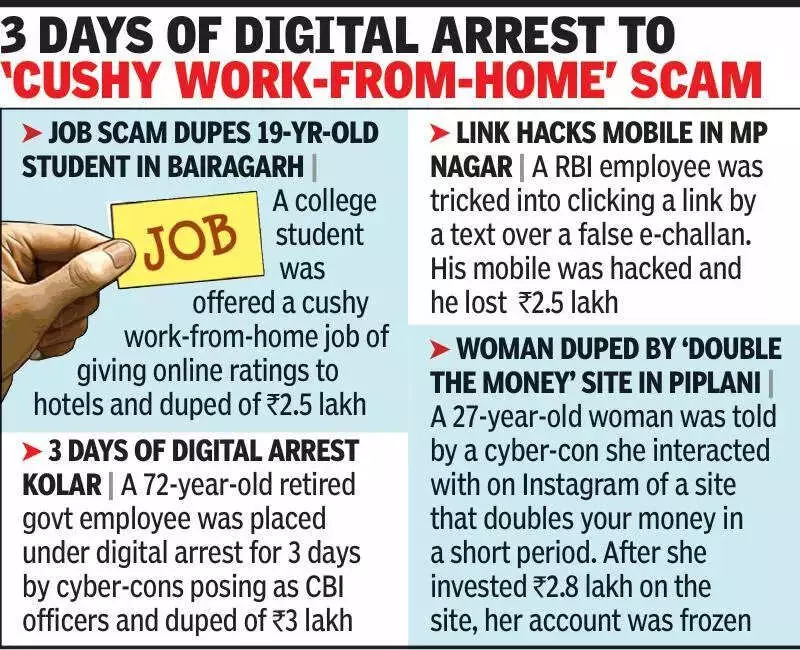
In the first case, Gaurav Tripathi, an RBI employee working at the MP Nagar branch, received a text message on January 6 around 1:30 PM. The message claimed he had a pending vehicle e-challan and contained a link. Upon clicking the link to verify, his mobile phone was compromised. Shortly after, fraudsters siphoned off Rs 2.5 lakh from his bank account in two transactions, prompting him to file a police complaint.

Retired Official Held in 'Digital Arrest' for 3 Days
In a more harrowing case, Jagannath Rathore, a 72-year-old retired electricity department employee living alone in Kolar, was targeted. On January 4, he received a call from individuals posing as CBI officials who claimed his SIM card was used in fraudulent activities. The scam escalated to a WhatsApp video call from a person in a uniform pretending to be a CBI sub-inspector, who placed Rathore under a 'digital arrest' for three days. Intimidated by the agency's name, he complied. The fraudsters eventually duped him of Rs 3 lakh.
Student Lured by Work-From-Home Job Offer
A 19-year-old student, who assists her father in running a dairy and operates his UPI account, was ensnared by a work-from-home scam. In July 2025, she received a call about an online job. After expressing interest, she was contacted on Telegram and given tasks like rating hotels. She initially earned Rs 450 on August 1, 2025. However, by August 4, she discovered that Rs 1.55 lakh had been transferred from her father's dairy account in 14 transactions. The fraudsters then promised a refund but demanded an RTGS transfer of Rs 1 lakh, which she paid. Only when they asked for more money did she contact the National Cyber-Crime Helpline.
Instagram Promise of Doubled Money Leads to Loss
In the fourth incident, a 27-year-old woman was contacted on Instagram by a fraudster who promoted a website that promised to double investments quickly. After moving the conversation to Telegram, she clicked the provided link and invested a staggering Rs 2.87 lakh. Her account on the website was then frozen. When she sought to unfreeze it on January 3, she was asked to pay an additional Rs 2.42 lakh, leading her to finally approach the Piplani police.
An Urgent Call for Enhanced Vigilance
The fact that these four distinct scams succeeded on the same day, despite ongoing police campaigns, underscores a critical gap between awareness and practical safety. The cases reveal that fraudsters are meticulously tailoring their approaches—using authority (fake CBI arrest), urgency (e-challan), opportunity (job offers), and greed (investment doubling)—to exploit psychological triggers.
The key takeaways for citizens are clear:

- Never click on unverified links received via SMS or social media.
- No government agency conducts 'digital arrests' or demands money over video calls.
- Be extremely skeptical of online job offers that require access to personal financial accounts.
- If an investment opportunity sounds too good to be true, it almost certainly is.
These incidents in Bhopal serve as a stark reminder that cyber vigilance must become a daily habit, not just a topic for occasional awareness drives.