Indore Police Issue Alert on Rising Exam Paper Scams Targeting Students
As exam season intensifies, students often sacrifice sleep, bury themselves in revision notes, and navigate class groups on their phones. Amid this stress, a deceptive message flashes on screens: 'Exam paper available.' For weary students, it might seem like a shortcut to success, but for cyber criminals, it's a calculated trap.
Indore police have observed that such fraudulent messages proliferate annually during board and annual examinations. These offers typically arrive through social media chats, unsolicited calls, or links that guarantee access to exam papers for a small upfront payment.
No Papers, Just Fraud: The Harsh Reality
Instead of receiving promised papers, victims face financial loss and data theft. Families report losing money within minutes, and in numerous instances, phones become infected with malware that steals personal data just days before critical tests.

Additional DCP Rajesh Dandotiya explained, "Our cyber team has identified similar advertisements circulating on Instagram, with identical patterns visible on Telegram and WhatsApp, where links promising exam papers are widely shared. Children often trust these messages, click the links, or transfer money, but every offer we've investigated has proven fraudulent."
He added, "We are actively tracking accounts behind these posts and coordinating with platforms to remove them. Parents must monitor their children's online activities during exam time and report suspicious links immediately for timely action."
Exploiting Emotional Vulnerability
Dandotiya highlighted that scammers deliberately target periods of high emotion. "Exam time creates a sense of urgency. Students feel they cannot afford to miss any opportunity. Criminals exploit this panic to push for quick payments and unsafe downloads," he said. Once money is transferred or a link is opened, recovery becomes challenging, replacing exam stress with financial anxiety.
Educators and Experts Weigh In
Teachers note that psychological pressure makes students particularly susceptible. Senior educator Neha Rajput stated, "Every year, we remind students that no legitimate authority sells papers online. These messages are fraudulent. Instead of aiding preparation, they distract children and undermine confidence right before exams."
Parents are encouraged to integrate cyber awareness into exam preparation. Experts recommend open discussions about online traps, rejecting unknown offers, and promptly reporting suspicious messages to the national cyber helpline at 1930.
Police Commissioner Santosh Kumar Singh emphasized, "We appeal to students and parents not to fall for these traps. No legitimate authority sells or shares papers through social media. If anyone receives such a message, they should report it immediately."

Key Points on the Fraudulent Scheme
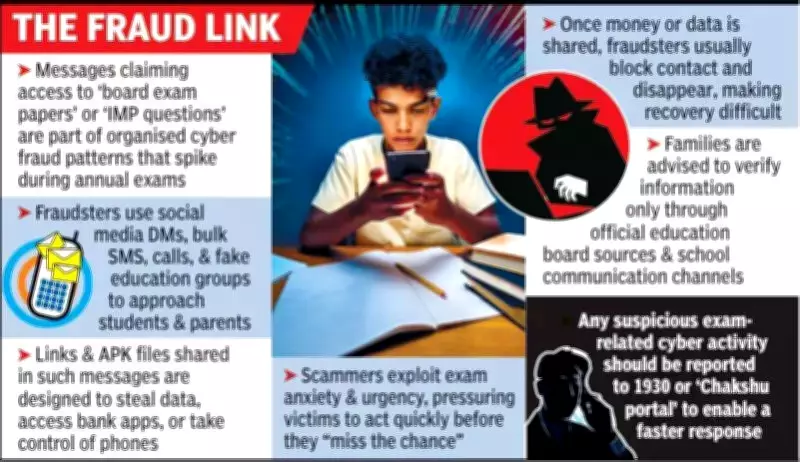
- Messages claiming access to 'board exam papers' or 'important questions' are part of organized cyber fraud patterns that spike during annual exams.
- Fraudsters use social media direct messages, bulk SMS, calls, and fake education groups to approach students and parents.
- Links and APK files shared in such messages are designed to steal data, access bank apps, or take control of phones.
- Scammers exploit exam anxiety and urgency, pressuring victims to act quickly before they "miss the chance."
- Once money or data is shared, fraudsters typically block contact and disappear, making recovery difficult.
- Families are advised to verify information only through official education board sources and school communication channels.
- Any suspicious exam-related cyber activity should be reported to 1930 or the 'Chakshu portal' to enable a faster response.