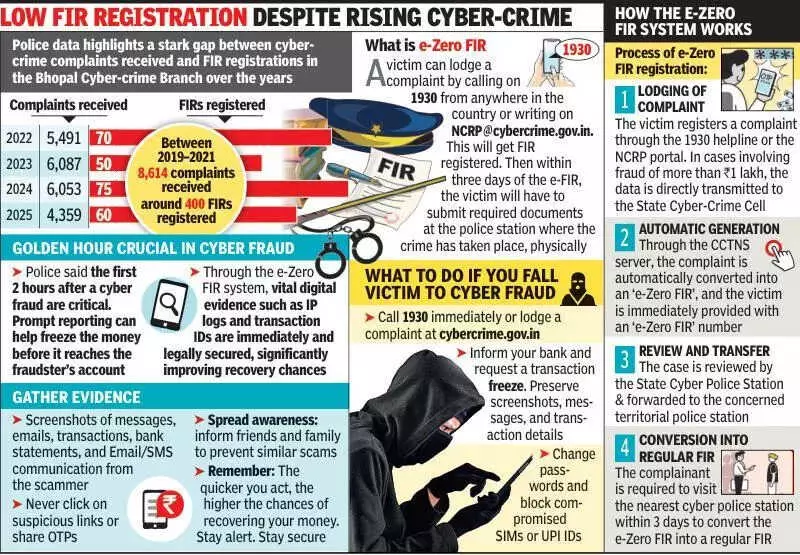
In a significant move to tackle the escalating menace of cybercrime, Madhya Pradesh has rolled out the e-Zero FIR system, positioning itself as the second state in India after Delhi to adopt this digital mechanism. The system, which received legal sanctity under Section 173 of the Bharatiya Nagarik Suraksha Sanhita (BNSS), officially went live on December 25. It is specifically designed for cases of cyber financial fraud where the amount involved exceeds Rs 1 lakh.
How the e-Zero FIR System Works and Its Immediate Impact
The revolutionary aspect of the e-Zero FIR is that it liberates victims from jurisdictional hurdles. Citizens can now file a complaint online from any location in the country, irrespective of where the crime was actually committed. This is primarily done through the National Cyber Crime Reporting Portal (NCRP) or by calling the dedicated 1930 helpline. Once registered, the e-Zero FIR is forwarded to the concerned police station for the formal registration of a regular FIR.
Since its launch, the state cyber-crime cell has already processed and forwarded approximately 100 e-Zero FIRs to relevant police stations across Madhya Pradesh. Police authorities acknowledge that the actual number of complaints received is substantially higher. A senior officer highlighted that even in instances where a regular FIR was pending, immediate preventive actions like blocking bank accounts or freezing fraudulent transactions were initiated swiftly to protect victims' funds.

Relief for Public, Increased Load for Police
This system is hailed as a major relief for victims, who often faced the arduous task of making multiple visits to police stations to get an FIR registered. SP Pranay Nagvanshi of the MP State Cyber-Crime Headquarters emphasized that a single call to 1930 is now sufficient to trigger the legal process. He stressed that speed is critical in cybercrime, where life savings can vanish in minutes, and this system enables police to issue legal notices to banks and obtain crucial evidence like CCTV footage without delay.
However, police officials have voiced concerns about the increased investigative burden. The system is expected to cause a surge in registered cybercrime FIRs, but no additional resources have been allocated to handle this spike. "The system is beneficial for the public, but the investigation load will increase significantly," an officer noted, adding that the framework is still evolving. In some straightforward cases, the Cyber-crime Branch itself registers the Zero FIR and transfers the case diary to the appropriate city police station.
Future Proposals and the Need for Coordination
To address manpower constraints, a key proposal is under discussion at the Indian Cyber Crime Coordination Centre (I4C). Currently, only inspectors or higher-ranking officers can investigate cybercrime cases. The proposal seeks to empower sub-inspectors and above to handle these investigations, leveraging their greater numbers across the force.
Furthermore, given the pan-India and remote nature of cyber fraud, effective inter-state coordination is paramount. Officers confirmed that efforts are being intensified to streamline collaboration with police forces in other states. This enhanced coordination aims to reduce the dependency on physical raids, thereby saving time and resources while accelerating the process of apprehending offenders.
The introduction of the e-Zero FIR system in Madhya Pradesh marks a proactive step in modernizing the legal response to digital crimes, aiming to balance victim support with the operational challenges faced by law enforcement.