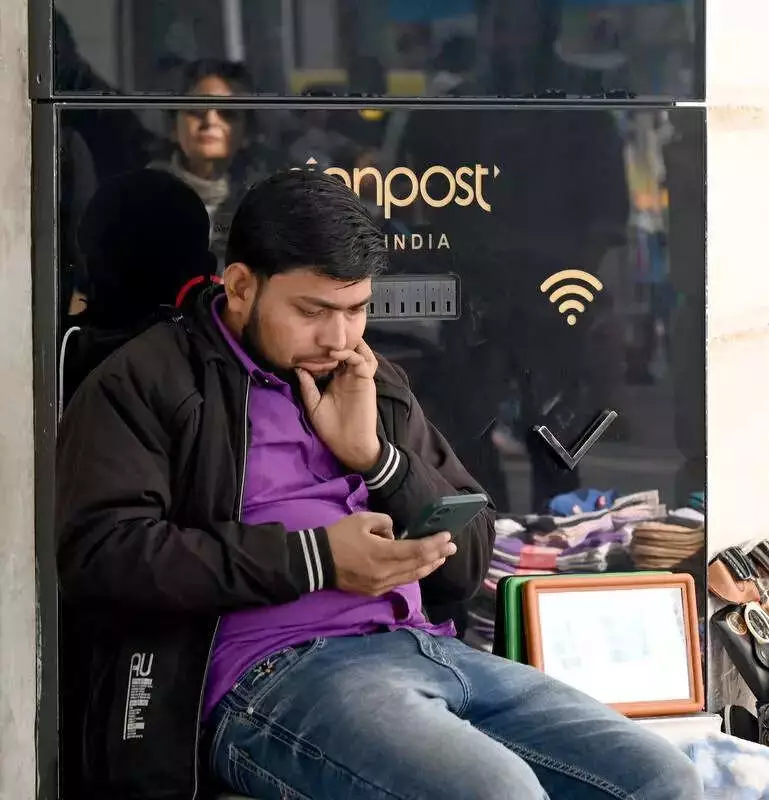
In the bustling heart of India's capital, a well-intentioned digital dream has turned into a daily nightmare for citizens. The story of Hemant, a 35-year-old shopkeeper in Connaught Place, perfectly encapsulates this failure. After closing his shop one evening, he found his phone battery at a critical 5% with the last metro departure imminent. Spotting a public charging station, he rushed to plug in, only to discover the ports were dead, leaving him digitally stranded.
A Grand Vision Meets Grim Reality
Hemant's frustrating experience is far from isolated. It highlights the stark contrast between a grand governmental plan and its current, dilapidated state. Back in 2018, the New Delhi Municipal Council (NDMC) partnered with MTNL (now BSNL) and a private digital firm to launch the ambitious 'CP LYF' project. The vision was to transform Connaught Place into a digitally connected public zone, featuring:
- 50 public Wi-Fi hotspots offering up to 1GB of free data per user monthly.
- Approximately 400 smartphone charging ports across the inner and outer circles.
- Digital infotainment displays for maps and market information.
However, a recent spot check reveals a vastly different and disappointing picture. The promised digital utopia is now a landscape of neglect and dysfunction.

Infrastructure in Decay: From Non-Functional to Non-Existent
The reality on the ground is one of systemic breakdown. The public Wi-Fi, while technically accessible via a portal using a phone number and OTP, provides a connection so weak and patchy that sending a simple WhatsApp message becomes a challenge. The charging infrastructure tells an even grimmer tale.
Across CP, numerous charging sockets are missing, hang loose, or are covered in layers of dust and grime. Many are simply non-functional. Rohan, a 32-year-old phone case seller, explains the cycle of vandalism: "Intoxicated people and ragpickers often steal the ports to sell for a small sum. If they can't steal them, they scratch them with blades or stones to make them unusable." He adds that while officials occasionally repair the damage, the vandals return after market hours, creating a futile loop of repair and ruin.
Compounding the problem is a severe lack of public awareness. Priyanka, a 23-year-old college student and regular shopper, admitted, "I've seen these smart displays but thought they were just for ads. I had no idea they offered free Wi-Fi and charging." The NDMC's failure to run sustained promotional campaigns has rendered these so-called "premium points" invisible to the very public they were meant to serve.
Encroachment, Ads, and Hidden Cyber Risks
The project's other components have also faltered. The digital displays, intended for public guidance, are now dominated by advertisements, with some screens completely blank. Physical access is another hurdle. Pankaj, 25, a frequent visitor, noted, "Nearby stalls have completely encroached upon the space in front of these panels, making them difficult for the public to reach."
Beyond neglect, these defunct facilities pose latent cybersecurity threats. The open Wi-Fi authentication method (phone number and OTP, without a secure password) is considered an easy entry point for hackers. Similarly, tampered public charging ports can be weaponized to install malicious hardware that compromises a smartphone the moment it is plugged in.
When questioned about the project's status, an NDMC official stated that the facilities were installed under the 'Smart City' project in collaboration with BSNL, which oversees their functioning, user data, and network operations. The official mentioned that BSNL's technical teams inspect the 50 premium points "from time to time". However, no clarity was provided on any plans to upgrade or seriously revive the services. BSNL did not respond to queries regarding the maintenance failures.
The crumbling 'CP LYF' project stands as a cautionary tale for India's smart city ambitions. It underscores that installing infrastructure is only the first step; sustained maintenance, public engagement, and security oversight are crucial for digital public amenities to truly serve the people of Delhi.