The Karnataka government's initiative to install smart meters for new electricity connections across the state has encountered significant administrative challenges, exacerbated by confusion arising from a Supreme Court order on mandatory occupancy certificates (OCs).
Smart Meters and the Supreme Court Order
Smart meters are designed to reduce transmission losses, improve billing efficiency, and enable real-time monitoring of electricity consumption. However, the Supreme Court's decision, aimed at enforcing building compliance norms, has inadvertently slowed the push towards modernizing the power sector.
Launched nearly a year ago, the program initially covered all new and temporary electricity connections under the Bangalore Electricity Supply Company (Bescom) and Chamundeshwari Electricity Supply Company (Cescom) jurisdictions, before expanding to the other three Electricity Supply Companies (Escoms).

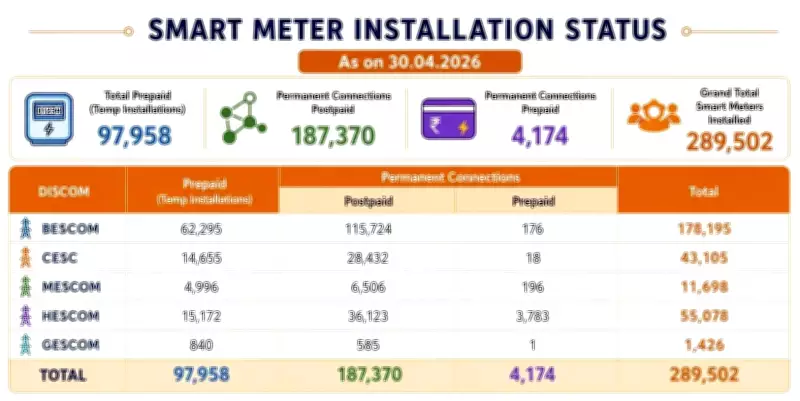
Official data accessed by Times of India reveals that only 2.9 lakh smart meters were installed as of April 2026, far below initial projections.
Impact of the SC Order
The court mandated that electricity connections for new buildings could only be issued upon submission of valid OCs. Energy department officials stated that uncertainty over the implementation of the order led to confusion among consumers, builders, and even field-level Escom engineers.
Escoms responded by putting lakhs of applications for new power connections on hold, particularly in urban areas where numerous apartment complexes and residential layouts awaited OC approvals. The Karnataka State Licensed Electrical Contractors Association (KSLECA) estimates that some 15-16 lakh applications were stalled.
“Yes, lakhs of households were initially affected, but the state cabinet’s decision to intervene and relax implementation procedures provided major relief. Over the past six months, we’ve installed nearly three lakh smart meters,” an energy department official said. The official added that the initiative would gain momentum in the coming weeks since Escoms have now resumed processing new applications aggressively, especially in Bengaluru and other urban centres.
Installation Statistics
Among the five Escoms, Bescom recorded the highest number of installations with 1.8 lakh smart meters, followed by Hescom (Hubballi) with 55,078, and Cesc (Mysuru) with 43,105. Mescom (Mangaluru) installed 11,698 meters, while Gescom (Kalaburagi) recorded the lowest at 1,426.
However, most of these installations—97,958—were temporary prepaid connections, while 1.9 lakh permanent postpaid smart meters were installed. Permanent prepaid smart meter adoption remained low at just 4,174 connections statewide.
“Most prepaid connections were for under-construction buildings,” an official explained. “These will eventually be converted to smart meters after completion of work and issuance of OCs by municipalities and corporations.”
Industry Concerns
C Ramesh, president of KSLECA, said: “Had the government intervened earlier, the rollout would have been faster. The government only eased rules for properties on 30x40 plots. Of the 15-16 lakh properties awaiting smart meters, 30-40% would have benefited, but many others are still awaiting new connections, and the state government must act proactively to resolve the confusion. It is losing revenue in the meantime.”