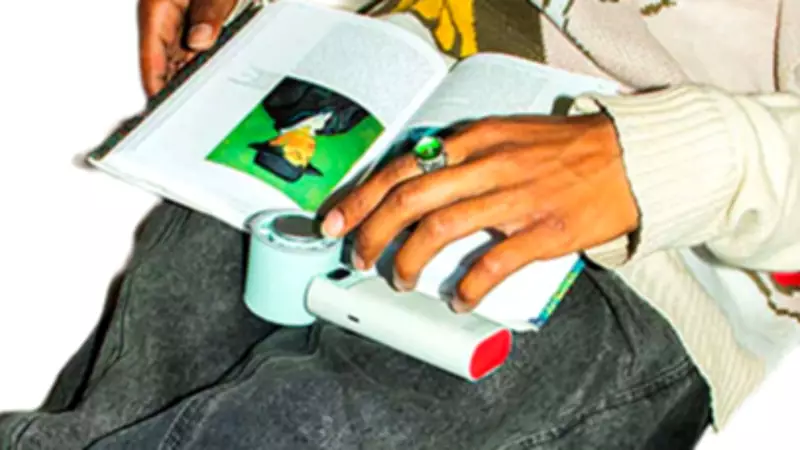
The BFF arrived on a Thursday, which in Delhi in late May meant it arrived at exactly the right time and also about a month too late. I unboxed it, charged it overnight, and put it in my bag the next morning without thinking too much about it.
The first time I actually used it was on the metro platform at Rajiv Chowk. Not because I had planned to, but because the platform was doing what metro platforms do in summer: trapping warm air and holding it still while you wait. I pulled the BFF out, turned the dial to around 40, held it near my face for the four minutes until the train came. It worked. I put it back in my bag when the train arrived and took it out again at the next platform when I had to change lines. That is mostly how it has gone since.
A Hundred Speeds That Are Not Just Marketing
The BFF has one control: a ridged dial on the side of the handle. Double-click to turn on, single-click to turn off, rotate to move through 100 speed settings, long-press for the cooling mode. The display next to it cycles between speed and battery percentage. That is the whole interface, and once you are used to it you stop noticing it.

The 100 speeds are not a gimmick. At 20 the fan is quiet, almost background. At 60 it is purposeful—you feel it from half an arm's length away. At 100 the BLDC motor runs at 13,000 RPM and it is loud enough that the person next to you will look up. I spent most of my time between 45 and 65, which was enough to be useful without being conspicuous, and gave me five to six hours of battery on a charge. The 3,600 mAh cell charges in about three and a half hours over USB-C and runs while plugged in, which I needed exactly once but was glad for.
The one thing I kept getting wrong: single-click is off, double-click is on. My hands kept doing it the other way. Two weeks in and I am mostly past it, but it is the kind of inconsistency that should not be there.
IceTouch: Real Cooling, Use It Wisely
IceTouch—long-press the dial—drops the surface of the fan to around 5 degrees Celsius using a Peltier element behind the head. You press it against your wrist or neck, and the air coming through is cooler than ambient. On humid days you will see condensation forming on the front of the device.
I tried it properly for the first time on a Saturday walk back from the market—fifteen minutes, full sun, the kind of afternoon that makes you reconsider most of your life choices. I held it to my face with IceTouch on for the last five minutes. It does not fix the heat. You are still outside, still warm. But there is a meaningful difference between the walk with it and the walk without it, and that difference is what the feature is selling, and it delivers. The catch is that IceTouch roughly halves your battery life at any given speed, so I started using it in short stretches—a few minutes when it was actually needed, not a setting I left running.
Two Weeks In: Just Part of the Bag
The BFF had stopped being something I thought about. It was just in my bag—out at the bus stop, back in, out again at my desk in the afternoon when the room got warm. The pouch it came with is still on my desk. The fan just goes straight into the front pocket now.
At Rs 2,299 it is not something you buy without thinking. But two weeks in, on a May that had no interest in being reasonable, I would have been genuinely annoyed to be without it. That is probably the most accurate thing I can say about it.