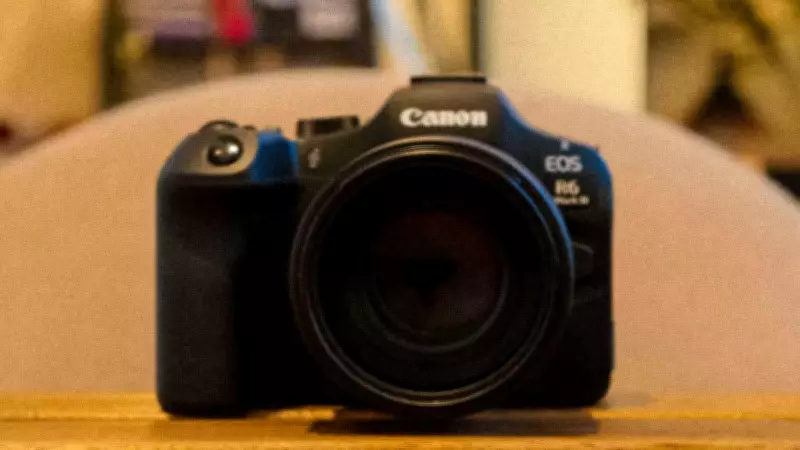
Canon EOS R6 Mark III: The Quiet Achiever Evolves into a Hybrid Powerhouse
The Canon R6 series has consistently occupied a unique niche in the camera market. It is not the entry-level dream machine for beginners, nor is it the budget compromise for constrained enthusiasts. Instead, it thrives in the productive middle ground—a tool for serious photographers who demand professional capability without the astronomical cost of flagship models. Three years after the Mark II became Canon's bestselling mirrorless body, the Mark III arrives with an ambitious proposition: more resolution, faster performance, cinema-level video specs, and autofocus that feels almost supernatural. Priced at Rs 2,43,995, it represents a significant investment. After extensive testing, we explore whether it delivers on its lofty promises.
Familiar Ergonomics, Enhanced Internals
Unboxing the R6 Mark III triggers immediate muscle memory. The body shape, button placement, and deeply sculpted grip that comfortably wraps around four fingers remain identical to its predecessor. Canon added a mere 29 grams during engineering, a negligible difference that goes unnoticed after a full day of shooting. This design conservatism is not laziness; it is a respectful nod to photographers who have built intricate workflows around specific ergonomics. The mode dial falls precisely where your thumb expects it, the joystick is perfectly positioned for rapid focus adjustments, and the photo/video switch on the left shoulder allows seamless transitions without menu diving.
The construction features a polycarbonate shell with a magnesium alloy internal frame, striking an ideal balance between rugged durability and portability—essential for hiking to remote locations or navigating crowded events like wedding receptions. Weather sealing provides protection against dust and light moisture, offering enough confidence to shoot in unfriendly conditions, though it is not submarine-grade.

Significant upgrades lie beneath the surface. Canon has replaced the dual SD card slots with one CFexpress Type B slot paired with a UHS-II SD slot. This configuration caters to serious shooters: CFexpress handles demanding modes without bottlenecking, while the SD slot offers flexibility for everyday tasks. The frustrating micro-HDMI port from the Mark II is gone, replaced by a full-size HDMI connector—a welcome change for videographers who have experienced cable failures mid-shoot. However, the electronic viewfinder and rear LCD carry over unchanged at 3.69 million dots and 1.62 million dots, respectively. While functional, competitors at this price point offer larger, sharper viewfinders that enhance extended shooting sessions.
32.5 Megapixels: Unlocking Creative Freedom
The Mark III makes its loudest statement with a sensor upgrade. Canon has jumped from 24.2 to 32.5 megapixels—a 34% resolution increase that positions this camera squarely against rivals like the Sony A7 IV and A7 V. This bump is not merely a spec sheet number; it translates to practical advantages. Increased resolution provides greater cropping freedom. Whether capturing a distant kingfisher with a telephoto lens or removing an unwanted photobomber from a wedding shot, photographers retain ample resolution for substantial prints. Street photographers who frame loosely gain considerable latitude to tighten compositions in post-production.
The sensor shares DNA with Canon's EOS C50 cinema camera, hinting at its video ambitions. Yet, it reads out quickly enough to maintain the burst speeds that made the R6 series famous. Dynamic range is impressive, with RAW files holding recoverable detail in both highlights and shadows in high-contrast scenes. Canon's color science continues to deliver warm, flattering skin tones beloved by portrait photographers without heavy post-processing. High ISO performance remains competitive up to approximately 12,800, where noise is controlled and detail preserved. Beyond this, degradation occurs, though files at ISO 25,600 are usable in a pinch. Notably, the native ISO ceiling has dropped from the Mark II (64,000 versus 102,400), which may concern astrophotographers or extreme low-light specialists, though most real-world shooting occurs well below these extremes.

40 Frames Per Second: When Excess Becomes Essential
At first glance, 40 frames per second seems excessive for most photography. Landscapes are static, portraits rarely require machine-gun bursts, and even sports and wildlife typically suffice at 20fps. However, "nearly every" situation is not "every" situation. Microsecond moments—a hummingbird hovering before darting away, a batsman's cover drive, a toddler's fleeting expression shift—are precisely where 40fps proves its worth.
The R6 Mark III maintains this speed with full autofocus and auto-exposure tracking on every frame, using the electronic shutter only. This mode introduces a caveat: the sensor drops to a 12-bit readout, slightly reducing dynamic range compared to the mechanical shutter's 14-bit output. Most photographers will not notice in typical conditions, but those aggressively lifting shadows in post-production should prefer the mechanical shutter when flash sync and absolute silence are not required.
Canon has doubled the buffer from the Mark II, allowing 150 RAW files before the camera slows down—roughly 3.7 seconds of continuous firing at maximum speed. Paired with a fast CFexpress card, clearing this buffer takes about 10 seconds, providing headroom that lets photographers stay immersed in the moment.
Pre-continuous shooting emerges as a standout feature. When enabled, the camera silently buffers 20 frames upon a half-press of the shutter, saving nothing to the card. When the decisive moment occurs—a Jenga tower collapsing, a dog leaping for a frisbee—a full press saves those pre-buffered frames alongside subsequent shots. This effectively negates reaction time, as the camera begins capturing before the photographer consciously decides. Unlike the Mark II's clunky Raw Burst mode, the Mark III treats pre-capture images as normal RAWs or JPEGs, ready for immediate editing in any preferred workflow.
Autofocus: Borderline Unsettling in Its Precision
Canon's Dual Pixel CMOS AF II system has been refined with algorithms borrowed from the flagship R1 and R5 Mark II, resulting in performance that approaches witchcraft. During testing, the camera consistently spotted birds in flight, locked focus, and maintained tracking through banks, dives, and erratic direction changes, even when branches momentarily obscured subjects.
Human detection feels equally confident. The system understands the hierarchy of eyes, faces, heads, and bodies, switching priorities smoothly as subjects turn away or become partially obscured. Registered People Priority allows programming up to ten faces in order of importance, ensuring the camera prioritizes designated subjects in crowded scenes—a boon for wedding photographers covering receptions.
Low-light autofocus pushes down to -6.5EV with an f/1.2 lens attached, performing reliably in dim conditions like indoor evening gatherings or twilight woodland paths without hunting or hesitation. One notable absence is the Action Priority mode found on the R5 Mark II and R1, which optimizes tracking for specific sports. Canon attributes this to the lack of the Digic Accelerator co-processor in the R6 Mark III. While most users will not miss it, dedicated sports photographers should consider this limitation.
RF 45mm f/1.2 STM: The Affordable Fast Prime
Alongside the R6 Mark III, Canon introduced the RF 45mm f/1.2 STM lens, an unassuming yet powerful addition. Priced at around Rs 39,000, it is remarkably affordable for an f/1.2 aperture, especially when compared to Canon's own RF 50mm f/1.2 L (over Rs 2 lakh) or Sigma's 50mm f/1.2 (over Rs 1.25 lakh).
Compromises exist: no weather sealing, longitudinal chromatic aberration causing purple and green fringing in high-contrast areas, corner softening wide open, and noticeable focus breathing during video. However, center sharpness at f/1.2 is excellent, with rendering that delivers the creamy, three-dimensional quality sought from fast glass. Backgrounds melt into smooth bokeh while subjects pop forward with presence. Weighing 346 grams, it is nearly half a kilogram lighter than premium alternatives, making the combination with the R6 Mark III balanced and portable. The 45mm focal length splits the difference between 35mm's environmental context and 50mm's portrait compression, landing in a versatile sweet spot.
Video Capabilities That Rival Dedicated Cameras
The R6 Mark III's video specs read like a cinema camera product sheet: internal 7K RAW recording at 60fps, open gate 7K at 30fps using the entire 3:2 sensor area, 4K at 120fps without cropping, oversampled 4K 60p from a 7K readout, Canon Log 2 and Log 3 for grading flexibility, four-channel audio, and waveform monitor with false color for exposure accuracy.
Open gate deserves special mention. Traditional video crops the sensor to 16:9 widescreen, discarding the top and bottom. Open gate captures the full 3:2 rectangle, allowing post-production flexibility to choose aspect ratios—16:9 for YouTube, 9:16 for Instagram Reels and TikTok, or 1:1 square. During shooting, the camera can display two aspect markers simultaneously, enabling framing for multiple deliverables without separate takes.
The catch? No built-in cooling fan. Extended 7K RAW recording can trigger thermal shutdowns, a trade-off for maintaining a compact hybrid body. During testing, overheating was not encountered, but sessions did not push continuous recording to extremes. Videographers needing unlimited RAW recording should consider the EOS C50, which shares this sensor but adds active cooling.
Canon's continued refusal to license the RF mount to third-party manufacturers limits lens options. While first-party lenses cover essential focal lengths, Sony E-mount and Nikon Z-mount offer dramatically wider selections from Sigma, Tamron, and Viltrox.
Battery life is rated at 620 shots in power-saving mode or 510 in standard mode—respectable for mirrorless but not exceptional, so heavy shooters will want spares.
Verdict: Should You Invest?
At over Rs 2,00,000, the R6 Mark III enters competitive territory. Sony's A7 V matches resolution and may exceed dynamic range but offers fewer video tricks and a less comfortable grip. The Nikon Z6 III brings a partially stacked sensor and superior viewfinder for slightly less money but trails in autofocus sophistication.
The R6 Mark III delivers the most complete package in its class. It is ideal for wedding photographers seeking a capable second body, content creators splitting time between stills and video, wildlife and sports shooters valuing speed and tracking without flagship pricing, and enthusiasts upgrading from older bodies who want a camera that won't limit their growing skills.
If you currently shoot the original R6, the Mark III represents a substantial upgrade across every metric. If you are on the Mark II and your work does not demand higher resolution or advanced video, the jump is harder to justify—your current camera remains excellent.
There is no single feature that rewrites the rulebook, and some omissions feel like missed opportunities at this price: the unchanged viewfinder, lack of active cooling limiting prolonged RAW video, and Canon's closed RF mount ecosystem restricting third-party lenses. These are real trade-offs worth weighing.
However, none undermine what Canon got right. The autofocus inspires confidence, the speed captures moments others miss, the video capabilities satisfy serious production demands, and the image quality rewards careful post-processing while delivering excellent results straight from the camera. Specialist cameras have their place, but sometimes you need one that does everything well—and the R6 Mark III is exactly that.
Our rating: 4/5