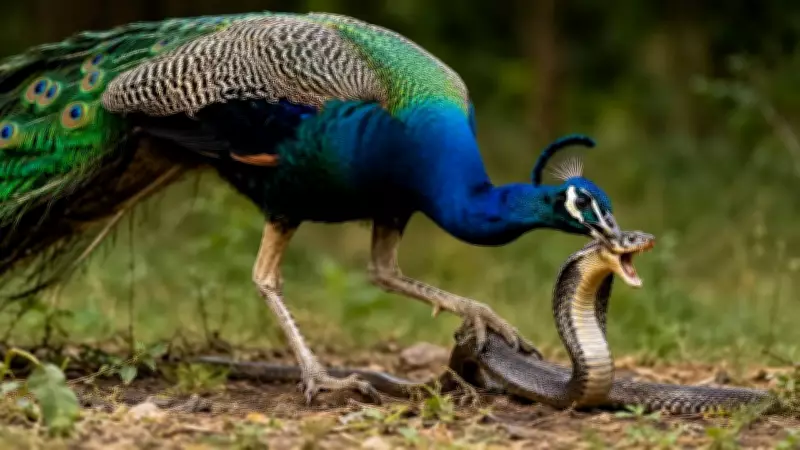
A peacock standing over a snake has become such a familiar image in parts of South Asia that many people barely question it anymore. The bird's reputation as a snake hunter has travelled through folklore, farming communities, and wildlife documentaries alike. Yet the sight remains puzzling. Cobras and other venomous snakes possess toxins capable of killing large animals, so how can a bird attack, kill, and swallow them without suffering the same fate?
The answer turns out to be less straightforward than many popular explanations suggest. Scientists studying the long-running contest between snakes and the animals that prey on them have discovered that different species survive snake encounters in very different ways. Some rely on biological resistance. Others appear to succeed through behaviour, physical adaptations, and a remarkable ability to avoid being bitten in the first place.
How Do Peacocks Survive Venomous Snakes' Venom?
As reported by the Universiteit Leiden, birds presented a different picture altogether. When researchers looked at species famous for killing snakes, including hawks, eagles, secretary birds, peafowl, and the red-legged seriema, they expected to find at least some evidence of similar molecular defences. Instead, they found very little to suggest these birds possess specialised genetic resistance to venom.

That result raised an obvious question. If they are not especially resistant, why are they so successful? The answer may lie in the fact that birds approach the problem differently. Rather than depending on internal protection, they seem to avoid receiving dangerous bites altogether.
Speed, Feathers and Sharp Eyesight
A snake strike happens in fractions of a second. Many snake-hunting birds appear exceptionally well equipped to handle that challenge.
Their eyesight allows them to track movement with impressive accuracy. Their reactions are fast. Their bodies are light and agile. Some species possess protective feathers and tough scales on their legs, creating an additional barrier between themselves and a snake's fangs. Field observations have shown that birds often attack with careful precision. They may spread their wings to distract a snake, force it to focus on the wrong target, and then strike towards the head or neck. The goal is simple: remain outside the danger zone while disabling the snake.
From an evolutionary perspective, that strategy may be so effective that specialised venom resistance never became necessary.
The Hidden Story Behind Snake-Eating Predators
For millions of years, snakes and the animals that hunt them have been locked in an evolutionary struggle. Venom evolved as a highly effective weapon, helping snakes subdue prey and defend themselves against threats. In response, some predators developed ways of reducing the danger.
This ongoing back-and-forth has attracted the attention of evolutionary biologists because it reveals how species adapt when survival depends on gaining even the smallest advantage. A predator becomes slightly better at avoiding venom. A snake becomes slightly better at defending itself. The question of how snake-eating animals survive encounters with dangerous reptiles has fascinated scientists for decades, particularly in regions where venomous snakes are common.
What About the Venom After the Snake Is Eaten?
This is where many popular explanations begin. Wildlife experts frequently point out that snake venom is dangerous primarily when it enters the bloodstream or sensitive tissues. Swallowing venom is a different matter. In many circumstances, digestive processes can break down venom proteins in much the same way they break down proteins found in food.
A peacock that swallows a venomous snake does not automatically inject venom into its body. The toxins pass into the digestive tract rather than directly into the blood. That does not mean venom becomes harmless under every condition. If venom enters through wounds in the mouth, throat, or digestive system, it can still present a serious risk. The distinction is important because it explains why eating a venomous animal is not necessarily the same as being bitten by one.