

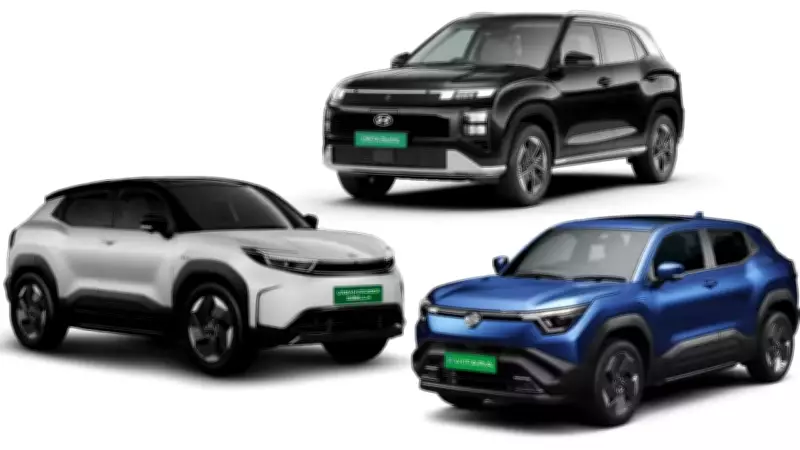
India's Electric SUV Market Heats Up with New Entrants from Maruti and Toyota
The landscape of India's electric vehicle sector is undergoing a significant transformation, particularly in the SUV segment. After witnessing intense competition among various models, two automotive giants, Maruti Suzuki and Toyota, have officially entered the fray. The much-anticipated Maruti Suzuki e-Vitara and Toyota Urban Cruiser Ebella are poised for launch, with their prices expected to be revealed imminently.
Upon their debut, these new electric SUVs will not only compete fiercely with each other but will also directly challenge the established Hyundai Creta Electric. This development marks a pivotal moment in the evolution of India's electric mobility, offering consumers more choices in the burgeoning SUV category.
Detailed Comparison: Battery, Range, and Power Specifications
Let's delve into a comprehensive analysis of how these three electric SUVs stack up against one another in terms of their core technical specifications.

Toyota Urban Cruiser Ebella: Dual Battery Options and Impressive Range
The Toyota Urban Cruiser Ebella is designed to cater to diverse consumer needs by offering two distinct battery configurations. Customers can opt for a standard 49 kWh battery pack or upgrade to a more substantial 61 kWh unit. The smaller battery is paired with a front-mounted electric motor that generates 144 horsepower, while the larger battery enhances the output to approximately 174 horsepower. Both versions maintain a consistent torque rating of 189 Nm.
Notably, Toyota claims that the Ebella equipped with the larger 61 kWh battery can achieve an impressive maximum range of up to 543 kilometers on a single charge, setting a high benchmark in this segment.
Hyundai Creta Electric: Competitive Power with Higher Torque
Hyundai's Creta Electric also provides buyers with two battery choices, though both are slightly smaller than those available in the Toyota Ebella. The entry-level variant utilizes a 42 kWh battery, while the long-range model features a 51.4 kWh pack. Power output varies across versions, ranging from about 135 horsepower to 171 horsepower.
A standout feature of the Hyundai Creta Electric is its superior torque, rated at approximately 255 Nm, which surpasses its rivals. Hyundai asserts that the larger battery variant can deliver a maximum driving range of 510 kilometers, making it a strong contender in the market.
Maruti Suzuki e-Vitara: Shared Platform with Toyota, Matching Performance
The Maruti Suzuki e-Vitara is closely related to the Toyota Urban Cruiser Ebella, sharing many technical underpinnings. It will be offered with 49 kWh and 61 kWh LFP (Lithium Iron Phosphate) battery packs. In its front-wheel-drive configuration, power figures range between 142 horsepower and 174 horsepower.
The larger battery version of the e-Vitara is claimed to offer up to 543 kilometers of range, matching the Toyota Ebella's performance. Torque is rated at 192.5 Nm, providing a balanced driving experience.
Charging Infrastructure and Ownership Benefits
All three electric SUVs support both AC and DC fast charging, ensuring convenience for users. Toyota is enhancing the appeal of the Ebella with comprehensive ownership support, including an eight-year battery warranty, flexible buyback options, and innovative Battery-as-a-Service plans.
Meanwhile, Maruti Suzuki is making significant investments in charging infrastructure to alleviate range anxiety among potential buyers. The company is collaborating with multiple charging partners and has ambitious plans to install chargers across its dealership network nationwide, thereby bolstering the EV ecosystem in India.
As the electric SUV market in India continues to expand, the arrival of the Maruti e-Vitara and Toyota Urban Cruiser Ebella introduces fresh competition, promising consumers advanced technology, improved range, and enhanced ownership experiences. This rivalry is set to accelerate the adoption of electric vehicles across the country.

