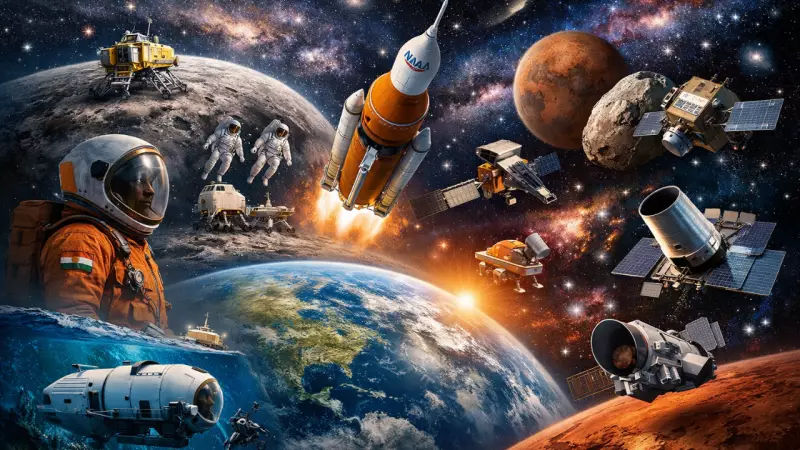
In the grand cosmic theatre, where light takes billions of years to cross the expanse, humanity is preparing for a series of audacious leaps closer to the stars. The year 2026 is poised to become a historic pivot point, marking a collective surge in space exploration that blends legacy, ambition, and cutting-edge science. From India's first steps towards independent human spaceflight to humanity's return to the Moon and beyond, the calendar is packed with missions that will expand our understanding of the universe and our place within it.
A Global Surge: Moon, Mars, and Beyond
The spirit of exploration is experiencing a powerful renaissance. NASA's Artemis II mission, targeting a launch as early as February 2026, will break a five-decade hiatus in human deep-space travel. Four astronauts—NASA's Reid Wiseman, Victor Glover, Christina Koch, and CSA's Jeremy Hansen—will embark on a 10-day journey to orbit the Moon. While they will not land, this critical test of the Orion spacecraft's life-support and navigation systems paves the way for future lunar surface missions and establishes a sustainable human presence beyond Earth's orbit.
Simultaneously, China is targeting the Moon's mysterious south pole with its Chang'e-7 mission, scheduled for launch in August 2026. This ambitious expedition, comprising an orbiter, lander, rover, and a mini-probe, will investigate the permanently shadowed craters believed to harbour water ice—a resource vital for future long-term lunar exploration.

The focus isn't limited to the Moon. Japan's Martian Moons eXploration (MMX) mission aims to travel to Mars's moon Phobos, collect samples, and return them to Earth. If successful, it will be the first sample-return mission from a Martian moon, offering unprecedented clues about the formation of Mars and the solar system.
India's Multi-Frontier Ascent in 2026
India is asserting its role as a major spacefaring nation on multiple fronts. The spotlight is firmly on the Gaganyaan programme's G1 mission, an uncrewed orbital test flight tentatively set for March 2026. This will be a full dress rehearsal, launching aboard ISRO's human-rated LVM3 rocket with the humanoid robot 'Vyommitra' on board. The mission will validate critical technologies—life support, communication, and safety systems—in a real Low Earth Orbit environment, with a paramount focus on the high-stakes re-entry and recovery phase.
Success here will place India on the cusp of its maiden human spaceflight, joining an elite global club. Concurrently, India's Aditya-L1 solar observatory is entering its most crucial phase. As the Sun approaches its peak activity cycle, or 'solar maximum', in 2026, Aditya-L1 will have a front-row seat to observe violent solar storms and coronal mass ejections (CMEs). Its unique ability to study these eruptions in visible light will provide vital data to protect satellites and infrastructure on Earth from disruptive space weather.
New Eyes on the Cosmos and Our World
The wave of exploration extends to powerful new observatories. The European Space Agency's PLATO space telescope, planned for launch in late 2026, will be a planet-hunting powerhouse. Using 26 cameras to monitor 200,000 stars, its primary goal is to discover and characterise Earth-like planets orbiting Sun-like stars, bringing us closer to answering the age-old question of whether we are alone in the universe.
China's Xuntian space telescope, destined to orbit the Tiangong space station, will conduct wide-field surveys to study galaxies and the enigmatic nature of dark matter. These missions, alongside India's deep-sea Samudrayaan project, underscore a holistic approach to exploration—reaching outward into the cosmos, studying our own star, and probing the depths of our home planet.
Collectively, the missions of 2026 represent far more than a crowded launch schedule. They signal a unified human endeavour to push boundaries, secure our future in space, and deepen our comprehension of the vast universe we call home. It is a year where decades of planning culminate in tangible steps that will inspire generations and redefine humanity's trajectory among the stars.