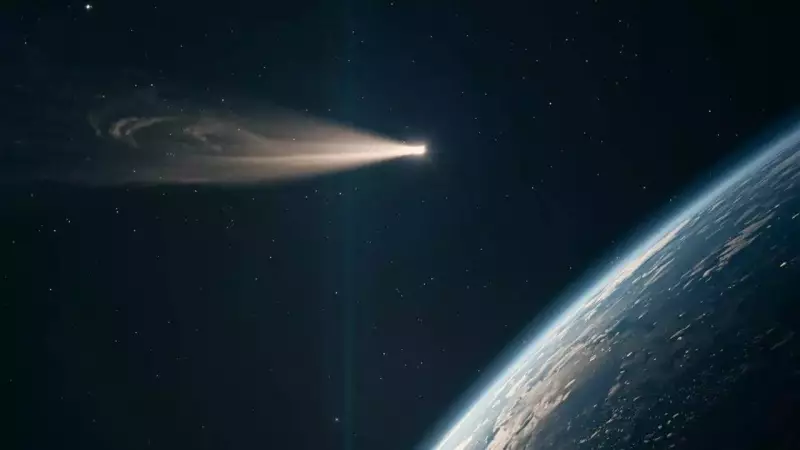
A rare and extraordinary cosmic visitor is currently passing through our solar system, offering astronomers an unprecedented glimpse into the building blocks of distant stars. This visitor is Comet 3I/ATLAS, only the third object ever confirmed to have originated from interstellar space, beyond our Sun's influence.
A Visitor from Another Star
Comet 3I/ATLAS is not a native of our solar system. Unlike local comets that formed with the Sun and its planets, this icy traveler was born in the orbit of a different star, potentially billions of years ago. It has been drifting through the vast, empty stretches of interstellar space for eons before its current trajectory brought it through our cosmic neighborhood. Its composition and behavior provide a completely new perspective on how other planetary systems form and evolve.
The comet was first spotted on 1 July 2025 by the ATLAS (Asteroid Terrestrial-impact Last Alert System) survey telescope located in Rio Hurtado, Chile. This NASA-funded project is part of a planetary defense network designed to monitor the sky for potential threats. The discovery was promptly reported to the Minor Planet Center, the official global repository for such findings.

Decoding the Name and Nature of 3I/ATLAS
The name itself tells the story of its significance. The '3I' denotes it as the third interstellar object ever discovered, following the famous 'Oumuamua in 2017 and Comet 2I/Borisov in 2019. The 'ATLAS' credits the telescope system that found it. Astronomers classified it as a comet because, as it approached the Sun, it developed a visible coma—a cloud of gas and dust—around its icy nucleus, a hallmark of cometary activity.
Estimates from Hubble Space Telescope observations on 20 August 2025 suggest the comet's nucleus is between 440 meters and 5.6 kilometers in diameter. Its most defining characteristic is its incredible speed, a clear sign of its interstellar origin. Initially detected moving at about 221,000 km/h, its velocity increased to roughly 246,000 km/h as it swung around the Sun.
Scientific Significance and Fleeting Opportunity
This comet is on a hyperbolic orbit, meaning it is moving too fast to be captured by the Sun's gravity. It is a temporary guest, already on its way back into the depths of interstellar space from whence it came. This one-way trip makes the current observation window critically important.
Scientists believe 3I/ATLAS was likely ejected from its home star system through gravitational interactions. It entered our solar system from the direction of the constellation Sagittarius, near the Milky Way's center. For researchers, it acts as a natural probe, delivering a pristine sample of material from another part of our galaxy. Studying its chemical makeup and comparing it to local comets can reveal fundamental differences in how planetary systems are assembled around other stars.
Experts have assured the public that this freezing visitor poses no danger to Earth. Instead, its brief flyby is a priceless moment for science. The data collected will help broaden our understanding of the diversity of objects in the Milky Way and bring us one step closer to comprehending our place in the universe. Once it departs later this week, the knowledge it leaves behind will be its lasting legacy.