

8 Unmissable Sky Events in April 2026: A Celestial Spectacle
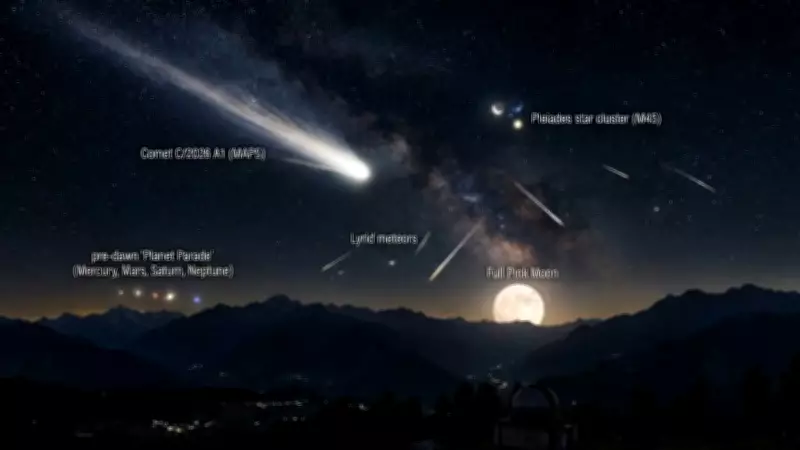
For astronomy enthusiasts and casual stargazers alike, April 2026 promises an extraordinary lineup of celestial events that will light up the night sky. From a blazing comet making a rare close approach to meteor showers and planetary parades, this month offers at least eight distinct opportunities to witness the universe in action. Mark your calendars for these astronomical highlights that combine beauty with scientific intrigue.
The Full Pink Moon (April 1)
The month begins with the first full moon of spring, occurring at 10:12 PM ET on April 1. Contrary to its name, the Pink Moon doesn't actually change color; instead, it references the seasonal blooming of Phlox subulata, commonly known as moss pink, across North America. Astronomically, this full moon coincides with perigee—the moon's closest point to Earth in its orbit—making it appear approximately 15% brighter and slightly larger than an average full moon. This phenomenon has led media outlets to classify such events as 'supermoons,' adding to their mythical allure.
Mercury at Greatest Western Elongation (April 3)
On April 3, Mercury reaches its maximum angular distance from the Sun, known as greatest western elongation. This positioning allows observers to spot the elusive planet very low on the eastern horizon just before sunrise. Typically, Mercury's proximity to the Sun makes it difficult to view due to solar glare, but this elongation provides a rare window for visibility. Scientists utilize these opportunities to study Mercury's tenuous exosphere and surface reflectivity, as reduced solar interference offers clearer observations for space-based sensors and high-altitude telescopes.

Comet C/2026 A1 (MAPS) Perihelion (April 4)
The highlight of April 2026 arrives on April 4, when Comet C/2026 A1 (MAPS) makes its closest approach to the Sun, passing within about 850,000 miles. Classified as a 'sun-grazing' comet, this icy body—often described as a dirty snowball—will experience rapid sublimation due to intense solar energy, creating a glowing coma and potentially a spectacularly long tail. If the comet's nucleus withstands the Sun's gravitational forces, it could develop into a 'Great Comet' of 2026, with forward-scattering of light possibly rendering its tail visible even during morning twilight.
Pre-dawn Planet Parade (April 16–23)
From April 16 to 23, early risers can witness a rare planetary alignment featuring Mercury, Mars, Saturn, and Neptune clustered within a 10-degree section of the sky. This visual phenomenon, known as a planetary conjunction, occurs due to line-of-sight perspective, as these planets are actually millions of miles apart in space. Such alignments are valuable for astronomical research, aiding in the calibration of wide-field telescopes and enhancing understanding of the ecliptic plane, which contains most solar system objects.
Moon, Venus, and the Pleiades Conjunction (April 18–19)
On April 18 and 19, the Moon and Venus will appear close to the Pleiades star cluster, creating a stunning celestial trio. This conjunction offers a picturesque view for observers, with the bright planet Venus and the crescent Moon juxtaposed against the sparkling stars of the Pleiades. Events like these not only captivate skywatchers but also serve as reference points for studying orbital mechanics and stellar distributions.
Lyrid Meteor Shower Peaks (April 22–23)
The Lyrid meteor shower reaches its peak on April 22–23, originating from debris left by comet C/1861 G1 Thatcher. As Earth traverses this debris trail, particles burn up in the atmosphere at speeds of 110,000 miles per hour, producing one of the oldest recorded meteor showers, with observations dating back 2,700 years. NASA monitors such events to assess risks from meteoroid impacts on satellites and the International Space Station, highlighting the practical importance of these celestial displays.

Galactic Sightings: The Whirlpool Galaxy (All Month)
Throughout April, Messier 51, also known as the Whirlpool Galaxy, presents its best face-on orientation for observation. Located 31 million light-years away, this galaxy is actively colliding with its smaller companion, NGC 5195. Astrophysicists use the Whirlpool Galaxy as a model to study star formation in spiral arms driven by gravitational interactions, making it a key target for both amateur and professional astronomers.
The 'End' of Northern Lights Season (Late April)
As daylight increases in the Northern Hemisphere approaching the summer solstice, the traditional aurora observational season concludes in late April. Despite ongoing solar activity, such as coronal mass ejections, the bright skies prevent human eyes from discerning the green and red ionized gases of the Northern Lights near the Arctic Circle. This transition marks the end of optimal viewing conditions for auroras until darker skies return.
April 2026 stands out as a month packed with celestial wonders, offering something for every sky enthusiast. Whether you're tracking comets, watching meteor showers, or observing planetary alignments, these events provide a unique glimpse into the dynamic nature of our universe.





