From Ranchi to Silicon Valley: Adi Prasad's Vision for Human-Free Factories
Adi Prasad grew up in Ranchi, a heavily industrialized city in what is now Jharkhand, where he watched molten metal transform into machines. Today, he is on a mission to remove the human hand from manufacturing entirely, believing this is the most human thing he can do. On a Sunday morning in February, Prasad heads into his office in Silicon Valley, where weekends are more philosophical than practical, with the cheerful demeanor of someone walking to a beloved park.
The Factory That Exists in Conviction
The factory does not yet exist in physical form, but it thrives as a gravitational force of conviction, pulling people, money, and talent toward it. Matter, the company Prasad co-founded with three others in late 2024, is setting up its first facility in Sunnyvale this month. Within it, he intends to demonstrate something many have theorized about but few have achieved: a factory floor that operates without a human workforce, converting raw components into finished electromechanical products.
"Matter is changing the paradigm," Prasad declares with the confidence of someone whose arguments have become foundational. "Manufacturing has always been a human-dependent activity. We are decoupling the human from that process."

A Childhood Shaped by Industry
Prasad's early years in Ranchi were spent wandering through nearby plants, observing raw materials become finished products. "It was like a big toy," he recalls. His father, a doctor, nurtured his curiosity with engineering diagrams and library trips. By age five or six, Prasad had already hacked a circuit board at home, foreshadowing his future path.
He chose MIT over IIT, calculating probabilities at seventeen. The civil service exam, pursued by many uncles, had sub-one-percent selection rates, while engineering at a top institution offered better odds and agency. Prasad is inherently averse to outcomes dictated by luck, preferring high-agency, thoughtful bets.
Education and Early Career Insights
At MIT, Prasad discovered an education system focused on application over memorization, treating engineering as interdisciplinary. He took economics and humanities classes, learning that building at scale requires understanding decision-making, markets, and institutional trust. "In order to become a great entrepreneur," he notes, "apart from engineering problem skills, you need to understand the world as a whole."
His first job at Tesla in 2014 placed him in a pivotal moment. Elon Musk was struggling with Model X Falcon Wing doors, calling manufacturing "insanely difficult." Prasad's manager, Charly Mwangi, later a co-founder, handed him the problem on his first day. As a new graduate, he was unprepared by conventional standards, but he solved it.
Redefining Ambition Through Scale
Musk then assembled a small team to rethink the factory of the future from first principles. Prasad participated, contributing to innovations now industry standard. "Once you go through that experience," he says, "smaller problems become less exciting." Proximity to genuine scale recalibrates one's ambitions.
After Tesla, Prasad worked at Apple and Rivian, where he joined the battery manufacturing team during COVID. His colleague Aish Varadhan is now Matter's CTO, and co-founder Aditya Ranjan has been a friend since MIT. The fourth co-founder, Charlie, promised to write the first check when Prasad started his company, and he did.
The Matter Vision: Beyond Humanoid Robots
Matter's autonomous factory does not feature humanoid robots. Prasad finds that framing frustrating, noting such robots lack the precision and speed for real production. Instead, Matter builds flexible, reconfigurable production lines with distributed robotic systems:
- Conveyor robots
- Arm robots
- Laser welding stations
- Adhesive dispensers
All are coordinated by Matter OS, a proprietary operating system that unifies them into a single intelligence. The product is manufacturing capacity itself: send an engineering drawing, receive a finished product.

Decoupling Manufacturing from Geography
The business logic is profound. By decoupling manufacturing from human labor, it also decouples from geography. No longer chasing cheap labor to China or Mexico, production can occur anywhere—in the US, Europe, or eventually India. "80% of world GDP is manufacturing," Prasad explains. "The way to increase GDP per capita is to increase goods and services. And till today, that has always been tied to human labor." He traces this from pyramids to shipping containers and Foxconn, arguing industry history is about overcoming human limitations.
Current Traction and Influences
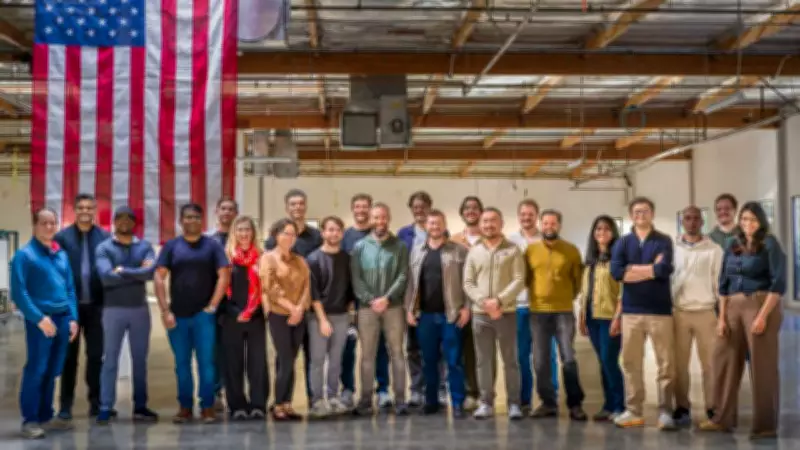
Matter now employs twenty-five people, with a defense company as a customer, a robotics partner, a hyperscaler, and a new hire from Google. The seed round closed last September, with angels including Tesla's former head of autonomous driving and Google's head of AI infrastructure.
Reflecting on mentors like Musk, Travis Kalanick, and RJ Scaringe, Prasad highlights epistemological lessons:
- From Musk: Intolerance for "that's how it's been done" explanations.
- From Kalanick: Respect for the difficulty of changing entrenched industries.
- From Scaringe: Understanding that product, brand, and detail are integral to engineering.
He carries a belief that bets must match the moment's stakes. With access to schools, mentors, and genius-level entrepreneurs, building something incremental would be, in his word, "regretful."
Looking Ahead with Determination
The Sunnyvale factory will soon be complete. Prasad will likely be there on a Sunday, bridging what exists and what he envisions. The gap is vast, but he remains untroubled. "I knew I had an acumen for engineering," he says, thinking back to Ranchi. "And I loved every moment of being an engineer. I still do. I don't think I can be in any other profession." With a smile, he heads into the office, ready to build the future.