

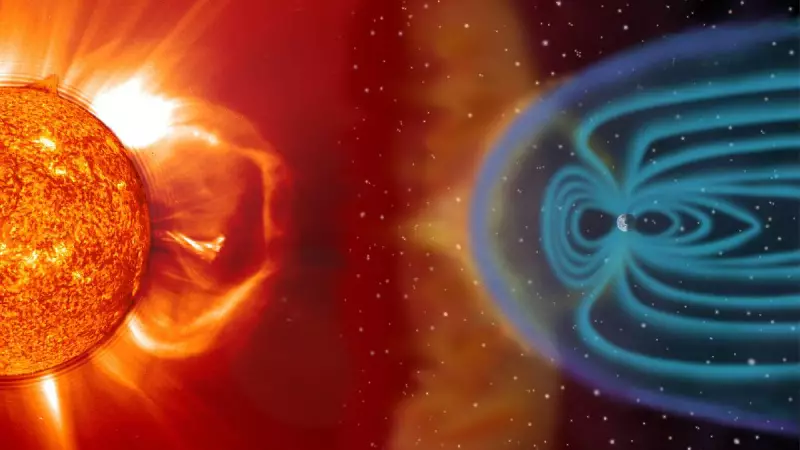
In a landmark discovery for space science, India's first solar observatory, the Aditya-L1 mission, has successfully captured and analysed the dramatic impact of a powerful solar storm on Earth's protective magnetic shield. The Indian Space Research Organisation (ISRO) announced that data from the spacecraft's instruments revealed a significant compression of the magnetosphere, the region dominated by Earth's magnetic field, due to the onslaught of charged particles from the Sun.
Aditya-L1's Front-Row Seat to a Solar Tempest
The critical observations were made during a significant coronal mass ejection (CME) event that erupted from the Sun on January 10-11, 2026. Positioned at the strategically important Lagrange Point 1 (L1), approximately 1.5 million kilometres from Earth towards the Sun, the Aditya-L1 spacecraft had a unique, uninterrupted view of both the solar eruption and its subsequent journey toward our planet. This vantage point is crucial as it allows for continuous solar observation without any occultation or interference.
The key instrument behind this discovery is the Aditya Solar wind Particle EXperiment (ASPEX). ASPEX is designed to study the solar wind and its composition. During the January 2026 event, it detected a sharp increase in the flux of high-energy protons and alpha particles, signalling the arrival of the interplanetary shockwave associated with the CME. This data provided the first alert of the incoming storm.

Measuring the Magnetospheric Squeeze
The most compelling evidence came from analysing how this solar tempest interacted with Earth's magnetosphere. Under normal solar wind conditions, the magnetosphere acts as a robust shield, deflecting most solar particles and protecting the planet. However, the intense pressure from the solar storm caused a profound deformation.
ISRO's analysis confirmed that the subsolar point of the magnetopause—the boundary where Earth's magnetic field pressure balances the solar wind—was pushed inward from its typical distance of approximately 10-12 Earth radii to under 6 Earth radii. This represents a compression of nearly 50%, drastically reducing the volume of our planet's protective magnetic bubble. For a brief period, the magnetosphere was severely squeezed, allowing solar particles to penetrate closer to Earth than usual.
Implications for Technology and Space Weather Forecasting
This finding is not just an academic achievement; it has serious practical implications for our technology-dependent world. A severely compressed magnetosphere exposes satellites in geosynchronous orbit (at about 6.6 Earth radii) to the harsh solar wind, increasing the risk of:
- Satellite damage and malfunctions from charged particle bombardment.
- Disruptions to radio communications and GPS navigation systems.
- Increased radiation exposure for astronauts and high-altitude flight crews.
- Potential induction of damaging electric currents in long power grids on the ground.
The data from Aditya-L1 provides an unprecedented opportunity to refine space weather prediction models. By understanding the precise correlation between CME characteristics (like speed, density, and magnetic orientation) and the degree of magnetospheric compression, scientists can issue more accurate and timely warnings. This allows satellite operators, power grid managers, and airlines to take precautionary measures, potentially saving billions in infrastructure damage.
The success of this observation underscores the Aditya-L1 mission's vital role in advancing heliophysics. Launched in September 2023, the spacecraft has been steadily returning valuable data, but this analysis of a direct Earth-impacting event marks one of its most significant contributions to global space weather science. It firmly places India as a key player in solar research and planetary defence against solar threats.






