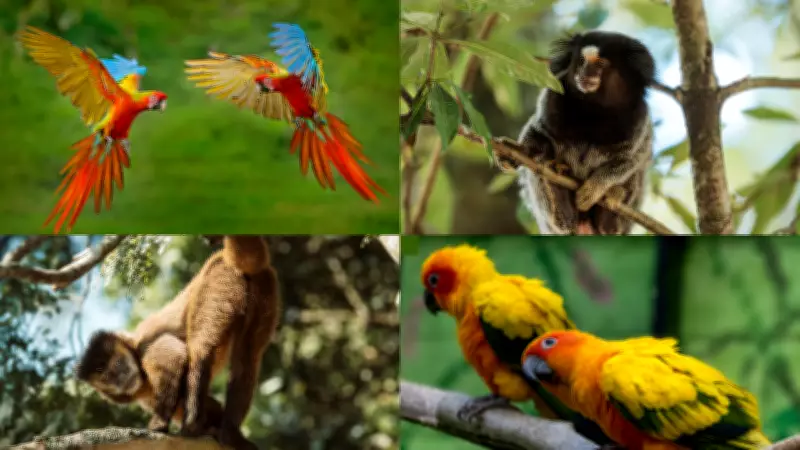
In the dense jungles of the Amazon rainforest, scientists have discovered a remarkable form of communication they call the 'internet of the forest'. Studies reveal that birds and monkeys in this region not only coexist but actively exchange vital information about potential dangers, particularly predators. This intricate communication system enables these organisms to survive in one of the world's most hostile environments.
Amazon Animals Use Shared Warning Signals to Stay Safe
Research shows that various species in the Amazon rely on each other for safety through a uniform means of communication. Some birds respond to alarm calls from monkeys, while certain monkeys react to avian alarm calls. This behavior is not random but learned, as detailed in the study 'Exploiting interspecific olfactory communication to monitor predators'. Primates like tamarins generate distinct alarm calls for airborne versus terrestrial predators, and birds understand these calls, taking actions such as fleeing or hiding. Conversely, monkeys respond to bird alarm calls specifically triggered by raptors. The findings state, 'Interspecific eavesdropping enables animals to utilize the sensory work of others, effectively extending their own monitoring systems.'
How Information Travels in the 'Internet of the Forest'
The term 'internet of the forest' aptly describes how information spreads rapidly among species, akin to data traveling between computers. While the internet relies on cables and signals, the forest version depends on sound, movement, and learned associations. Crucially, this system involves not just imitation but comprehension—animals understand that certain sounds carry specific meanings, effectively building a mental database. A participating scientist notes, 'These communication systems are dynamic and adaptive, allowing animals to make decisions based on the signs and calls of other species.' This indicates intelligence within nature. Interestingly, the interaction can involve multiple species, including birds, mammals, and even reptiles.

Ecological Significance and Future Research
Understanding this natural communication network has profound implications for conservation and ecology. If one species disappears, the entire system may collapse, reducing predator-detection efficiency for remaining species. This research opens new avenues in animal behavior and cognition, challenging the notion that communication is primarily species-specific. Scientists emphasize that protecting biodiversity is essential not only for preserving species but for maintaining these communication systems. As they note, 'The integrity of these systems depends on the diversity and stability of the community.' Future research aims to create a detailed map of these interactions and explore how environmental changes, such as deforestation, affect them. The 'internet of the forest' reveals the intelligent side of nature, showing that birds and monkeys are part of an interconnected survival network.