

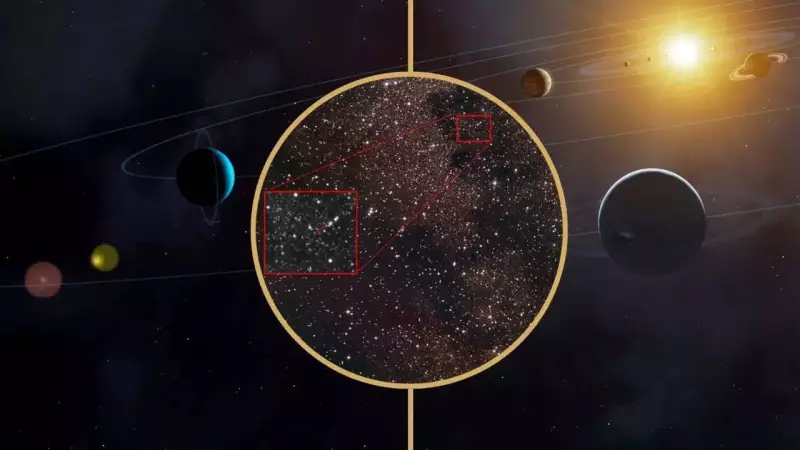
In a discovery that is reshaping our understanding of the cosmos, astronomers have identified a celestial visitor that is not just from another star system, but is potentially older than our Sun itself. This object, now known as 3I/ATLAS, is captivating the global scientific community with its ancient origins and unique properties, offering an unprecedented peek into the early history of our galaxy.
Discovery of a Cosmic Wanderer
The story began on 1 July 2025, when the Asteroid Terrestrial-impact Last Alert System (ATLAS) observatory in Chile picked up a faint, fast-moving speck of light. Its trajectory was immediately unusual. Unlike the countless comets and asteroids bound to our Solar System, this object was moving far too swiftly to be held by the Sun's gravity. Calculations soon confirmed the extraordinary truth: it was on a hyperbolic path, a visitor from the vast expanse of interstellar space merely passing through our neighbourhood.
This confirmation made it only the third such interstellar object ever documented, following the famous 1I/‘Oumuamua in 2017 and 2I/Borisov in 2019. Officially designated C/2025 N1 (ATLAS), it earned the informal but historic name 3I/ATLAS, marking its place in this exclusive club of cosmic travellers.

An Ancient Relic from the Galaxy's Dawn
While its interstellar origin was stunning, the true shock came when scientists began to unravel its age. Research led by Associate Professor Michele Bannister of the University of Canterbury suggests this comet is an astonishing 8 to 14 billion years old. To put this in perspective, our entire Solar System is a mere 4.6 billion years old. This means 3I/ATLAS likely formed around a star that died billions of years before our Sun was even born.
Its incredible speed of 58 kilometres per second relative to the Sun provides a clue to its birthplace. Such velocity indicates it originated in the Milky Way's thick disk, a region known to host some of the galaxy's most ancient stars. This comet is not just a visitor from another star; it is a primordial relic from the Milky Way's infancy.
Unique Chemistry and Lingering Mysteries
Spectroscopic analysis has revealed a chemical fingerprint unlike any typical Solar System comet. As it approached the Sun, its spectrum showed strong, unexpected lines of atomic iron and rare atomic nickel. Observations from the powerful James Webb Space Telescope further detected a significant amount of carbon dioxide, hinting that it formed in an extremely cold region far from its parent star.
This unique composition strongly supports the theory that 3I/ATLAS was forged in a stellar environment completely alien to our own. While the scientific consensus firmly labels it a natural object, its peculiarities have sparked debate. Notably, Harvard astrophysicist Avi Loeb has pointed to unusual features, such as unexplained brightness patterns and an "anti-tail" pointing towards the Sun, suggesting these anomalies warrant deeper investigation.
A Fleeting Opportunity for Science
According to NASA, 3I/ATLAS made its closest approach to the Sun in late October 2025 and passed nearest to Earth in December of the same year. While posing no threat to our planet, its rapid exit presents a challenge. After a predicted gravitational encounter in March 2026, it will be flung back into the interstellar void.
Scientists now face a race against time, with only a few hundred days left to study this ancient messenger. Its brief passage offers a one-of-a-kind window to analyse material that predates our Solar System, potentially holding secrets about the building blocks of galaxies. Once it departs, this chance to study a pristine piece of the early Milky Way will vanish into the darkness, making every observation with telescopes worldwide critically precious.






