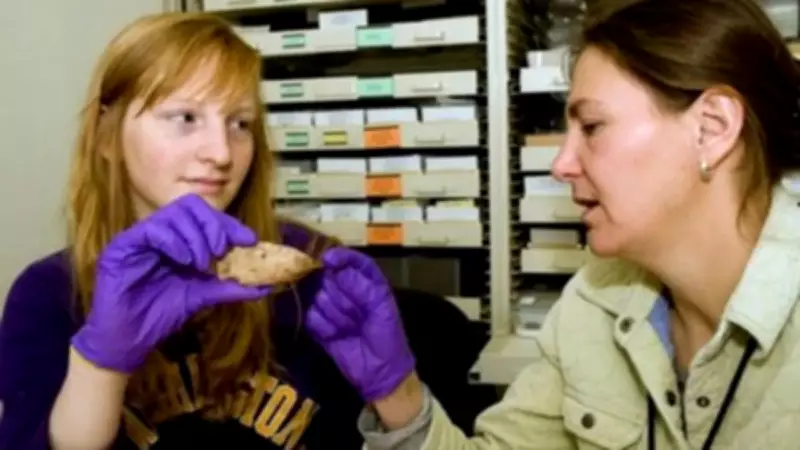
A small stretch of ground beside a chain-link fence on the University of Washington campus has revealed a far older story than expected. During routine volunteer work near the botany greenhouse, a shaped piece of flaked stone emerged from the soil. Its deliberate edges quickly distinguished it from ordinary debris.
Discovery and Identification
The artifact was later identified as a projectile point, larger and more carefully worked than a simple arrowhead. Specialists from the Burke Museum of Natural History and Culture returned to the site and excavated small test pits. Two additional stone tool fragments were found, scattered rather than neatly arranged, suggesting the ground had preserved them over time without any orderly pattern.
Age and Significance
The projectile point is estimated to be between 4,000 and 6,700 years old. This timeframe aligns with a period when volcanic ash from the eruption of Mount Mazama—which later formed Crater Lake—settled across the region, serving as a marker in archaeological layers. The tool's size and shape are consistent with other stone tools from the Pacific Northwest dating to that era. What makes this discovery unusual is its location: a busy university campus, buried under decades of construction, paths, and infrastructure.

Revealing Hidden History
The notion that this ground was ever unused is inaccurate. Archaeological records, historical accounts, and oral histories indicate that Indigenous communities lived across these lands for thousands of years before the university existed. Even into the late 19th and early 20th centuries, families remained connected to parts of what is now campus land before it was fully absorbed into university property. This continuity challenges modern assumptions about urban growth, as older presences were gradually folded under new layouts rather than simply cleared away.