Artemis II Crew Completes Historic Lunar Mission with Safe Earth Return
The Artemis II crew has made a triumphant return to Earth, concluding a nearly 10-day mission around the Moon. Early Saturday, their Orion spacecraft, named Integrity, splashed down in the Pacific Ocean off the coast of San Diego, as confirmed by NASA. This mission represents the first crewed lunar flyby in more than half a century, reigniting human exploration of deep space.
Dramatic Re-Entry and Landing Sequence
Commander Reid Wiseman, pilot Victor Glover, mission specialist Christina Koch, and Canadian astronaut Jeremy Hansen experienced a high-speed re-entry, travelling at Mach 33, which is 33 times the speed of sound. During this phase, the capsule became engulfed in red-hot plasma, with mission control entering a planned communication blackout. NASA successfully re-established contact as Orion re-entered Earth's atmosphere.
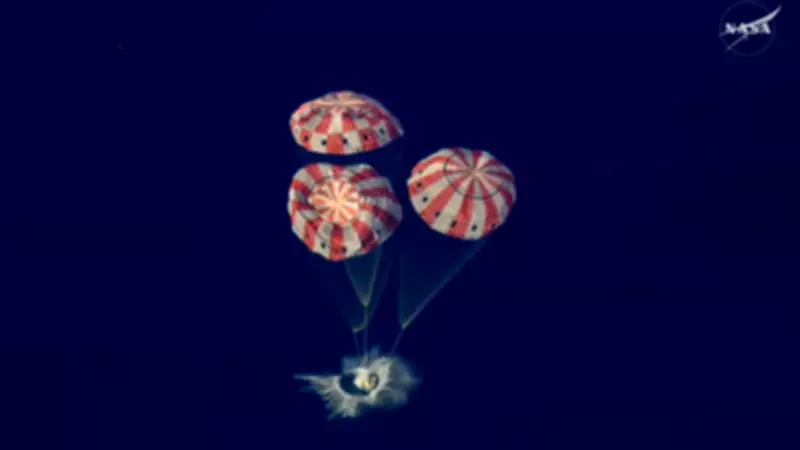
The landing was executed on automatic pilot, with a precise parachute-assisted descent:

- At 8:03 PM, drogue parachutes deployed at 23,400 feet, reducing velocity to 479 feet per second and stabilizing the spacecraft approximately 0.8 miles from splashdown.
- At 8:04 PM, the drogue chutes were cut, and three main parachutes deployed at 5,400 feet, slowing Orion to under 200 feet per second for its final descent into the ocean.
Recovery Operations and Crew Safety
Following splashdown, NASA confirmed the spacecraft remained stable in the water. Engineers conducted post-landing checks and powered down nonessential systems in preparation for recovery. The recovery director authorized teams from NASA and the U.S. military to approach the capsule using inflatable boats.
The astronauts were safely extracted from Orion onto inflatable rafts, referred to as the "front porch," before being transferred into U.S. military inflatable boats. They were then hoisted into U.S. Navy helicopters and flown to the recovery ship USS John P. Murtha. All four astronauts are safely aboard the vessel, where they have begun post-mission medical evaluations.
Post-Mission Procedures and Future Steps
NASA stated that the crew will later be flown back to shore and transported by aircraft to the agency's Johnson Space Center in Houston for further assessment. Recovery operations continue to secure the Orion spacecraft for transport. Teams from NASA, the U.S. Navy, and the U.S. Air Force are coordinating to bring the capsule aboard the USS John P. Murtha. It will then be returned to Naval Base San Diego and subsequently to Kennedy Space Center in Florida for detailed inspection, data retrieval, and post-flight analysis.
NASA shared splashdown footage on social media platform X, announcing the completion of this historic lunar crewed mission and highlighting the successful exploration of "our celestial neighbors." This achievement marks a significant milestone in NASA's Artemis program, which aims to return humans to the Moon and pave the way for future Mars missions.